Building a Fence Line Under Sherwood’s Mature Trees
Short version: a back yard under fifty-year-old oaks and pines is a wetter, dirtier, more crowded place to put a fence than an open lot two streets over. The canopy keeps the bottom of the fence damp, the roots decide where posts can go, and the limbs decide what happens on a bad night.
A lot of Sherwood sits under trees that were already there when the neighborhood went in. The subdivisions built from the seventies through the nineties north of Little Rock have big water oaks, sweetgums, and loblolly pines standing over the back property line. We work under them constantly, and the fences we pull out from under them fail in a pattern you can set your watch by.
Shade Keeps the Bottom of the Fence Wet
The single biggest thing a canopy changes is drying time. A fence in an open Sherwood yard gets direct sun for hours a day, and after a rain the bottom eight or ten inches of the boards dry out. Under a closed canopy in July, that same strip may not see direct sun at all. Central Arkansas humidity does the rest, and the wood stays damp against the soil for days.
So shaded fences fail from the ground up. The damage concentrates in the bottom four to six inches of every picket, where the wood meets the wet zone. When we pull a fence out from under trees, the top two thirds of the boards are usually fine and the bottom edge is soft enough to push a thumb through. We build for that: pickets held up off the grade, a rot board along the bottom that can be swapped later without disturbing the rest of the fence, and the setting graded so water runs away from the posts.
Leaf and needle litter makes it worse. A fence line is a wall that catches whatever the canopy drops, and once oak leaves and pine needles mat down against the base they hold water against the wood like a sponge. Through an Arkansas winter, with no sun to dry anything, that pile stays saturated for months. We have pulled six inches of packed needle mat off a fence base in February and found the boards behind it black and spongy.
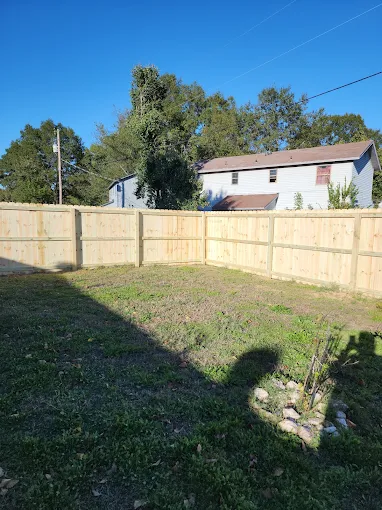
Routing a Post Line Around Roots
Digging a post line under a mature tree is a negotiation. The roots that matter are not the ones you picture going straight down. On central Arkansas clay, the feeder roots run wide and shallow, often in the top foot or so of soil, and they can extend well past the edge of the canopy. When we are augering along a line and hit a root the diameter of your wrist, we do not cut it and keep going.
What we do instead is shift the hole. Moving a post a foot either direction along the line usually clears the root, and nobody looking at the finished fence can tell. Where the line crosses a heavily rooted zone, we adjust post spacing across a few bays so the load lands on holes we could dig cleanly. If the only workable path means cutting into structural roots near the trunk, that is a conversation for a certified arborist, not for us with an auger. Where a tree sits relative to a property line is a survey question, and the City of Sherwood can tell you whether rules apply around protected trees.
When a Root Lifts a Post Later
Roots keep growing after we leave. A post set eight inches from one can have that root pressed against its concrete ten years on, and the root wins. You see it as a single post tilted while its neighbors stay true. Caught early it can be reset, and the honest move is to reset it a foot off rather than back into the hole the root already claimed. If a whole run has lifted, rebuild that run on a shifted line. It is also the best argument for steel posts under trees.
Limbs Come Down, and Materials Take It Differently
Sherwood gets ice, straight-line wind, and the occasional heavy wet snow, and old hardwoods shed limbs in all three. If your fence runs under a canopy, assume something lands on it eventually. What that costs you depends on what the fence is made of.
Wood takes limb impact in a way that is easy to repair. A falling branch usually breaks two or three pickets and leaves the rails and posts alone, and swapping pickets is a short job. Vinyl is closer to all-or-nothing: a glancing hit does nothing at all because vinyl flexes, and a heavy direct hit cracks a panel, which gets replaced rather than patched. Chain link is the most forgiving of the three. Fabric deflects and springs back, and even a real hit usually leaves a dent in the mesh and a bent top rail rather than a hole in the fence.
Nobody picks a fence purely on limb math. But if you are under a hundred-year-old water oak that already drops wood in every ice storm, it is worth weighing.
The Green Film Is a Wash, Not a Failure
Every shaded fence in central Arkansas eventually grows a thin green algae film on the side that never sees sun. Homeowners call us about it thinking the fence is going bad. It usually is not. Algae lives on the surface wherever moisture sits, and it shows up on vinyl and aluminum too, which tells you plainly that it is not eating anything.
It comes off with a hose, a soft brush, and a mild cleaner once a year. Pressure washing works but is easy to overdo on wood, where too tight a tip too close fuzzes the grain and opens it up to hold more water. What you are actually watching for is softness in the wood underneath. Pines add their own signature: sap hardens on the top rail and pine tannins streak light-colored fence faces, which washes off vinyl and aluminum but soaks into wood, so a mid-tone or darker stain hides far more than a clear sealer will.

Does the Canopy Change the Material Call?
The case for vinyl under trees is that the wet zone at the bottom of the fence means nothing to a material that does not absorb water, and algae wipes off a smooth surface in minutes. The case against is limb impact, plus the fact that vinyl’s other big selling point, UV stability, is worth less in a spot that barely sees UV. Our page on vinyl fences in Sherwood covers how those panels are built.
The case for wood is that it stays repairable, because under trees the failures are local: bottom boards, one post the roots pushed, three pickets a limb took out. Wood needs a design that anticipates the shade, meaning cedar at the ground, a sacrificial bottom board, steel posts where roots are in play, and stain over clear sealer. Read the product documentation on whatever you land on for what it says about ground contact. Details on our builds are on the Sherwood wood fence page.
The Maintenance Rhythm Is Different in Shade
A fence in full sun wants sealing on a cycle and otherwise wants leaving alone. A fence under trees wants less product and more clearing:
- Late fall, after leaf drop: rake the fence line clear on both sides. Highest-value thing on the list.
- Early spring: rake again, then walk the line checking post plumb and the bottom edge of the boards.
- Every few years: restain, picking a dry stretch and letting the wood dry several days first, because stain over damp wood in shade will not cure.
- After any ice storm or hard wind: walk the line and look up. Most limb damage we repair came off a branch that was already dead and hanging.
If your Sherwood back yard is under a canopy and you are thinking about a new fence or replacing one the shade already got, we will walk the line with you, look at where the roots and the overhanging limbs actually are, and price it honestly. See what we build across Pulaski County on our Sherwood service area page, or reach us through the contact form. Call Kade at (501) 626-7024.
Common Questions
Can you set fence posts through tree roots?
We do not cut through significant roots to make a hole work. We shift the post along the line, adjust spacing across a few bays, or change the alignment. Anything structural near a trunk should be looked at by a certified arborist, and the City of Sherwood can tell you whether rules apply around protected trees.
Is the green film on my shaded fence a sign of rot?
Usually not. Algae grows on the surface wherever moisture sits and shade prevents drying, and it shows up on vinyl and aluminum too, which do not rot at all. Wash it off at low pressure once a year. What to actually check is whether the wood underneath feels soft near the ground.
Should I take out the tree before fencing?
That is your call and an arborist’s, not ours. Plenty of Sherwood yards keep the canopy and get a fence that lasts by building it for shade: cedar or steel posts, a replaceable bottom board, boards held off the dirt, and a yearly clearing of the leaf line.
Which fence handles a falling limb best?
Chain link, by a wide margin, since the fabric deflects and springs back. Wood is next because broken pickets swap out in an afternoon. Vinyl shrugs off glancing hits and cracks under heavy direct ones, and a cracked panel gets replaced rather than patched.
How often should a shaded fence be stained?
Less often than the label suggests, and always in a dry stretch. Stain will not cure over damp wood, and under a closed canopy the boards hold moisture longer than they would in an open yard. Clear the leaf line first, let the fence dry several days, then stain.
Get a Free Fence Quote in Sherwood, AR
Delta Fence LLC serves Sherwood and Pulaski County. Licensed, insured, and bonded. Call Kade or fill out the contact form.
Call (501) 626-7024 Get a Quote