A Privacy Fence Where the Water Runs Through a Maumelle Yard
The short version: A solid privacy fence across the path of runoff acts like a low dam. Leave a gap at the ground where water travels, keep the bottom boards off wet clay, give the post in the low spot extra attention, and deal with any swale or downspout that dumps at the fence line before the posts go in. Ten minutes watching the yard in a hard rain tells you more than any drawing.
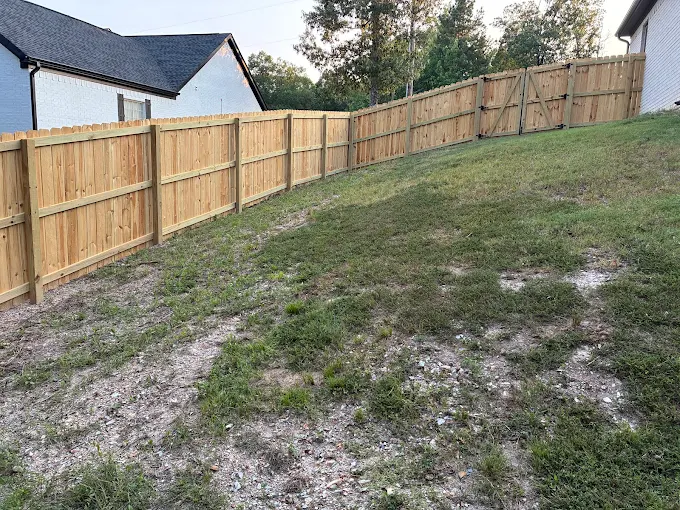
Most Maumelle back yards drain somewhere, and in a lot of subdivisions that somewhere is the property line. Lots are graded to shed water toward the back or the side, neighbors’ yards slope into each other, and a hard spring storm sends a sheet of water across the grass toward the same low corner it always finds. Put a solid wood privacy fence across that path without thinking about it, and you have built a small dam. This post is about the fence line where the water runs, and what we do differently there.
A Solid Fence Holds Water Back
Chain link lets water and leaves pass straight through. A board privacy fence does not. When runoff hits the bottom of a solid fence, it stops, spreads out along the line, and looks for the lowest way through. If there is no gap, it ponds on the uphill side until it soaks in or tops the low point.
That pond can be on your side or your neighbor’s, and either way it causes trouble. Standing water softens the ground around the posts. Leaves and grass clippings pile up against the boards and hold moisture against the wood. And if your fence sends water onto a neighbor’s patio that used to stay dry, you will hear about it.
The fix starts with knowing where the water goes now. Walk the yard in a real rain, or right after one, and look for the paths: the matted grass, the thin line of washed soil, the spot where mulch ends up every spring. Those are the places the fence has to let water through.
Leave a Gap at the Ground
Where runoff crosses the fence line, the bottom of the boards should sit above the soil with a clear gap underneath. Water and debris pass under, and the fence stops acting like a wall at the one place that matters.
The gap is a balance. Too tight and it clogs with leaves after the first fall. Too open and a dog will start digging at it, or a small dog will just walk under. In a yard with pets we usually keep the gap modest along the drainage path and close the rest of the line down near grade, so the opening only exists where water needs it. On a dog yard, a few concrete pavers or a strip of rock under the gap can stop the digging without blocking the flow.
What you want to avoid is filling the gap with soil or mulch later. Every spring somebody tidies up the fence line, and the gap disappears along with the drainage.
Keeping the Bottom Boards Off Wet Clay
Central Arkansas clay holds water like a sponge. A board that sits in contact with it stays wet long after the rest of the fence dries out, and wet wood is where rot and insects get their start. Even on stretches with no runoff at all, we keep the bottom of the pickets off the dirt.
Some owners add a horizontal kickboard along the bottom, set just above grade or slightly into it, so the pickets above stay dry and the kickboard takes the abuse. Swapping out one kickboard is a lot easier than replacing a run of pickets, and it gives a clean line at the base of the fence. Along a drainage path, the kickboard either lifts with the gap or stops on each side of it so water can still pass.
Grass trimmers do their own damage at the base, so a clear edge along the bottom helps both problems at once.
The Post That Sits in the Low Spot
Every wet yard has one post that lives in the worst of it, right at the bottom of the slope or where two yards drain together. That post spends more time in saturated ground than any other on the line, and it is usually the first to lean.
We set every post in concrete, and the one in the low spot gets extra thought. We dig it deeper, shape the top of the concrete so water runs away from the wood instead of collecting against it, and keep soil from being heaped up around the base. If there is a choice, we shift the post spacing a little so a post does not land in the very center of the wettest spot.
A gate in the low spot is a bad trade. Hinges and latches want posts that stay put, and a gate that swings through wet ground will drag through every rainy season. If the drawing puts the gate there, it is worth moving.
Swales and Downspouts That Dump at the Fence
Some lots have a shallow swale, a gentle channel shaped into the grade to carry water along the property line toward the street or a drain. Building a fence right down the middle of it is the fastest way to make a yard flood. The fence either goes beside the swale, leaving the channel open, or it crosses with a generous gap so the water keeps moving.
Downspouts are the other culprit. A gutter that empties onto the ground near the property line can put an entire roof’s worth of water against your new fence in a single storm. Before the posts go in, extend the downspout or turn it away from the fence line so the water lands somewhere it can spread. It is a small change that protects both the fence and the neighbor’s yard.
Our Maumelle privacy fence page covers the rest of the design side, and the Maumelle wood fence page goes into the lumber and fasteners we use.
Questions About Wet Yards and Privacy Fences
Will a gap under the fence let my dog out?
It can, so we size it to the yard. Along a drainage path the gap only needs to let water and leaves pass, and the rest of the line stays down near the ground. If your dog is a digger, a strip of rock or a few pavers under the opening keeps paws out while still letting the water through.
Should we fix the drainage before the fence goes in?
If you already plan to regrade, add a drain, or move downspouts, do it first. The posts get set to the finished grade that way, and nobody has to dig around a new fence later. Small fixes, like turning a downspout away from the property line, can happen the same day we build.
Can a privacy fence cross a drainage swale?
Yes, as long as it does not block it. We either run the fence beside the swale or cross it with a clear opening under the boards so the channel keeps carrying water. Blocking a swale usually sends water somewhere it was never meant to go, often into your yard or the neighbor’s.
Watch One Good Rain First
A privacy fence that respects where the water goes lasts longer and keeps the peace with the folks next door. Watch one good rain, take a couple of pictures, and send them to us. Kade will walk the line with you and point out where the gaps belong.
Bring Kade Out After the Next Hard Rain
Bring us out after the next hard rain if you can, while the water is still showing you where it goes. The visit is free, the quote is written, and the crew is licensed, insured and bonded.
Call Kade (501) 626-7024 Map My Fence Line