Maumelle Chain Link Fence Installation
Say chain link and most people picture silver mesh around a ball field. Black vinyl-coated fabric behind a Maumelle house looks nothing like that. It sinks into the lawn and the tree line, the yard still feels open, and the dog stays home. Delta Fence builds galvanized and black-coated runs with every post in concrete, and we check what your covenants allow first.
Starting the Run at a Shed or Outbuilding
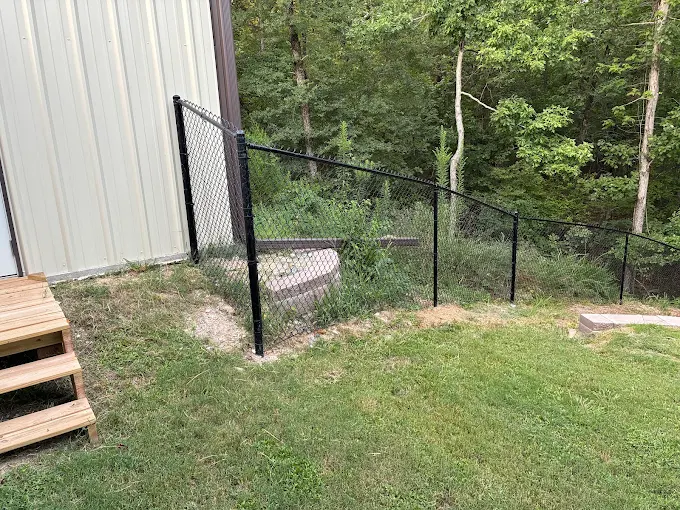
Plenty of back yards already have one hard edge: a shed, a detached garage, or a metal outbuilding sitting near the property line. Chain link can start right at that building, and when it is laid out well the finished fence looks like it was planned with the building instead of added years later. A black-coated run leaving the corner of a metal building and heading down a grassy side yard is about as tidy as a back yard fence gets.
The questions at a building are practical ones. Does it sit inside the fenced yard or outside it? Does its door need to swing open without hitting the new line? If a strip of grass is left between the wall and the fence, somebody has to trim it forever, so we usually bring the run to the corner and leave no strip at all. Where rain sheds off the roof, we keep posts out of the drip line so the ground around them is not soaked every storm.
If your subdivision has an HOA, the plan has to clear its fence approval before any of this gets built, and we work that into the schedule from the start. Our chain link fence service page covers the material in general terms across Central Arkansas.
A Dog Yard You Can Still See Across
Most chain link calls start with a dog. The appeal is simple. You can stand at the kitchen window and watch the whole yard, the dog can see out, and the grass you mow every weekend still reads as one lawn instead of a boxed-in pen. For plenty of families that open back yard is part of why they bought the house, and a solid wall around it would take that away.
A dog learns a fence from the bottom up. Give it a week and it will find the one place where the lawn has settled away from the mesh. We keep the fabric close to the dirt the whole way around and look hardest at the corners and the ground under the gate, where diggers usually go to work.
Chain link does have one weak spot with dogs: the barker. If it can see the sidewalk, it will announce the sidewalk, all day. For that dog a privacy fence tends to settle things down, and we will tell you so if that sounds like the dog you describe.
Tying Into the Fence Your Neighbor Already Built
Plenty of back yards come with one or two sides already fenced by the house next door. Using that fence is fine, as long as the connection is done right. Chain link is stretched tight, and that tension pulls on whatever post the fabric ends at. A neighbor’s wood post was never set to hold that pull, and within a season or two it starts leaning toward your yard.
So we set our own terminal post right beside the existing one and end the mesh there. Your fence stands on its own, their fence stays theirs, and nobody has to argue later about who fixes a shared post. The gap between the two posts gets closed tight enough that a small dog cannot squeeze through it.
Before we set anything along a shared line, we talk through where the property line sits, and it usually helps to give the neighbor a heads-up. A quick conversation over the fence now beats an awkward one next spring. If the neighbor’s fence is wood and you like the idea of matching it later, our wood fence page covers that side of things.
When the Covenants Say Black, or Behind the House
Chain link is the material HOA covenants tend to get most particular about, and in Maumelle subdivisions the rule usually comes in one of two shapes. One says chain link is fine as long as it is black-coated. The other says it is fine as long as it stays behind the house line, out of the view from the street.
A black-only rule raises a question worth settling before anything is ordered: does black mean the fabric alone, or the posts, rails, and gates too? Black mesh hung on silver framework is not what most neighbors picture when they read that rule, so we find out which reading your HOA uses. A behind-the-house rule changes the layout instead. The side runs return to the back corners of the house rather than coming forward, and the side gate lands closer to the back yard than you may have pictured.
Then there is everything that ends up against a back yard fence once a family starts living with it. In a subdivision yard the fence is often the only edge there is, so things drift toward it. A grill pushed back against the mesh bakes the coating on those few feet of fabric. Planters hung from the top slowly pull it out of line. A kids’ play set parked too close turns the fence into the next thing to climb, and a neighbor’s shrubs growing through the diamonds push on the fabric from their side every season.
None of that means you cannot use the yard right up to the line. It means telling us on the walk where the grill lives, where the swing set is going, and which shrubs belong to the house next door, so the run and its gates land where daily life will not be leaning on them.
Wooded Back Lots and Yards That Fall Away
Not every lot here is flat and open. Some back yards slope down toward a tree line, and some run right into the woods. Chain link handles that ground better than rigid panels, because the fabric can follow the grade, and we settle how to handle each dip after walking it with you.
Trees make the line harder to set. We need a clear path to walk and dig along, roots show up right where a post wants to go, and we would rather shift post spacing a little than cut through a big root beside a tree you want to keep. Low branches that would rest on the top rail are worth trimming before the crew arrives.
Wooded lots out on the western edge of town get one more question. Land close to Lake Maumelle can carry extra setbacks or buffer rules because it supplies drinking water to the Little Rock metro, so we check what applies before the line gets marked, and the fence never ends up somewhere it has to come back out of.
The Parts List on Every Run
- Every post set in concrete, with corner, end, and gate posts heavier than the line posts
- Galvanized or black vinyl-coated fabric, with framework to match when the covenants call for it
- Gate spots picked around the shed, the patio, and how the yard actually gets used
- Mesh kept close to the ground on every dog yard
- Owner Kade Endl overseeing the job, and a company that is licensed, insured, and bonded
Photos of finished runs are in the project gallery. If you already know what you want, send us your address and we will set up a time to walk the yard.
Chain Link Questions We Hear in Maumelle
Will my HOA approve a chain link fence?
It depends on your subdivision. Some Maumelle covenants allow chain link only behind the house, some require black vinyl-coated mesh, and some do not allow it at all. Knowing which rule covers your lot is the first thing we sort out, before any layout gets drawn.
Does the fence go right on the property line, or inside it?
Usually just inside it. Setting the posts a little onto your side keeps the whole fence on your property, so nobody wonders later whose fence it is. We talk through where the line sits before marking anything, and a survey helps if you have one. Your HOA may have its own rule on placement too.
Will black vinyl coating fade or chip?
Years of sun can dull it slowly. Chips mostly come from impact: a mower deck, a trimmer line, a grill shoved hard against the mesh. Where the coating does get nicked, the galvanized wire underneath still has its zinc, so a small chip is a looks problem long before it is anything else.
Can we add onto the fence later if we put in a pool or a garden?
Yes. Chain link extends well, since a new run can tie in at a sound corner or end post and the finish can be matched. A pool enclosure carries its own rules, especially around gates, so we check what applies before building that part. A garden usually needs only a short inner run with its own gate.
Will the install tear up the lawn along the line?
Not much. Chain link needs post holes and room to walk the line, and that is about all the digging there is. We keep the dirt out of your flower beds, and the strip where the crew worked fills back in with grass.
Can I let vines or shrubs grow on the fence?
Within limits. Light vines are fine on mesh with posts in concrete, but heavy growth adds weight and gives wind something to push on, and roots crowding a post make repairs harder. Some covenants have an opinion about what grows on a fence, so check yours before planting.
Out Toward Roland and North Little Rock
Chain link work takes us around Maumelle and past it, into Roland and North Little Rock, where plenty of back yards stop at a wooded lot instead of another fence. That is where see-through mesh makes the most sense: the dog stays in and the trees you bought the house for stay in view. If your yard backs onto woods, (501) 626-7024 reaches us.
Other Fences for Maumelle Yards
Maumelle Privacy Fences
Board-on-board and shadowbox runs for patios and back yards where seeing through the fence defeats the point.
Privacy fences →Maumelle Wood Fences
Cedar and pine in American-sourced lumber, screwed down and set on concrete posts.
Wood fences →Maumelle Vinyl Fences
Clean, uniform panels that never need paint or stain, a common pick in HOA neighborhoods.
Vinyl fences →Maumelle Commercial Fencing
Storage lot security, storefront frontage, and vehicle gates for local businesses.
Commercial fencing →Tell Us Where the Grill and the Play Set Live
Send the address, how much of the yard you want fenced, and your HOA’s fence rules if you have them. We look at the shed and the slope during a free on-site visit, then send a written quote that spells out the fabric, the finish, and each gate. Kade oversees the job. If the covenants or the yard point toward wood or vinyl instead, we say so on the visit. Licensed, insured, and bonded, with every post set in concrete.
(501) 626-7024 kadeendl@gmail.com Walk the yard with us