Skip to content

Roland Ranch Fencing

Roland Ranch Fence Installation

On Roland acreage, a fence is mostly about where your land stops. Out here that usually means X-rail or split-rail along the boundary. It marks the line and leaves the view alone, and next to an open field it looks like it was always there. We lay those runs out with string lines so they hold straight end to end, and we set every post in concrete, rock or no rock.

Boundary

Holding a Long Boundary Line Straight

A rail fence across a few acres shows every mistake. On a short back yard run, one post sitting slightly out of line disappears. On a long boundary it reads as a wobble from the road, and it never stops reading that way, because there is nothing solid in the fence to hide it.

So the line gets set before a single hole is dug. We pull a string from corner to corner, check it with a laser level where the ground rolls, and mark the post spacing off that string. Even spacing matters as much as a true line. Rails are cut to length, and if the posts wander, the rails stop fitting, which shows fast on a fence that is mostly open air.

Corners and ends carry the most strain on a rail fence, so they get the deepest holes and the most concrete. Our ranch fencing service page covers the styles we build across Central Arkansas, and the Roland fence page covers the rest of what we do out here.
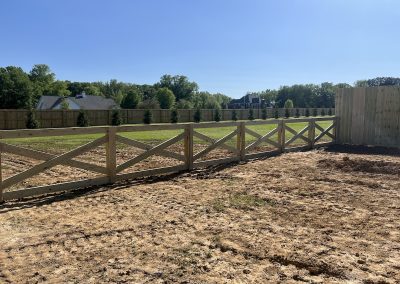
Pressure-treated wood X-rail fence across freshly graded dirt, with an open grass field, a wood privacy fence and a row of young evergreens behind it

Post Holes Where the Ground Fights Back

The ground around Roland gets rockier the closer a property sits to the Ouachita foothills. Some holes go down clean. The next one hits rock a foot or so down, and that is the moment a crew decides whether that post ends up as deep as its neighbors or a few inches short.

We do not settle for the short hole. On a rail fence, a shallow post is the first to tip, and when it tips it drags the rails on both sides with it. When a hole hits rock, we keep working it down to depth, then set that post in concrete like every other post on the job.

Rocky holes take longer, and that time costs less than straightening a section next year that leaned along with one short post. It also helps to know about the ground before the crew shows up. If you have hit rock putting in a mailbox or a garden bed, tell us where, and we will plan the day around it.

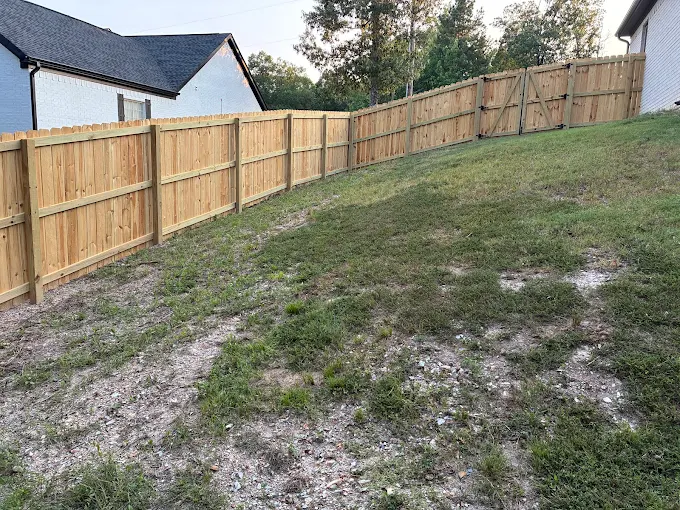
Dog-ear wood privacy fence climbing a grassy slope beside a white brick house, with a wood double gate near the top of the rise

Following the Roll of the Land

Very little acreage out here is flat. A boundary might drop into a low spot, climb a rise, and run level for a stretch before doing it all again. A rail fence has two ways to handle that ground, and the right one depends on how steep it gets.

Racking tilts the rails to follow the slope, so the bottom rail keeps about the same height above the dirt the whole way across. On gentle grade that is usually our pick, since the finished fence tracks the land the way your eye already reads it. Stepping keeps each section level and drops it at the post, like a staircase. On steep ground it looks cleaner, though it leaves a triangle of open space under each step.

For rail fencing, those gaps rarely matter, since the job is marking a line. If something on the property does need to stay put, say so early. It changes the answer, and sometimes it means a different fence for that corner, like one of the dog kennel fences we build in Roland, set inside the bigger boundary.

Privacy at the House, Rail at the Edge

A lot of Roland owners end up with two fences, and it makes sense the minute you walk the property. Near the house you want a solid wall for the patio, the back door, and the part of the yard the road can see. Out at the property line you want something that marks the boundary and leaves the field open.

The photo on this page has both. A wood X-rail runs across newly graded ground in front, and a wood privacy fence stands behind it with a row of young evergreens along the line.

Where the two styles meet is the part worth planning. We usually end the privacy fence at a heavy post and start the rail from its own post a short step away, so each fence carries its own load. If the solid section needs to be more than plain boards, our page on custom fences in Roland covers horizontal screens and mixed builds. A wide opening between the two is a natural spot for a drive gate, and the Roland secure gating page walks through how we hang those.

County Rules Before the First Hole

Roland is unincorporated, so fence rules come from Pulaski County. Depending on how your property is zoned, the county may have setbacks from the road and limits on height. A rail fence along a road frontage is exactly the kind of fence those rules are written about.

We look into what applies to your parcel before marking the line, and we help with the permitting for Roland jobs. A survey helps a great deal on acreage. Corner pins on rural land can be hard to find, and an old fence line is not always on the property line, so if you have a survey, have it out when we walk.

Brush is the other thing to settle early. A boundary that runs through scrub or along a tree line needs a path wide enough to walk the string and dig, cleared a few weeks before the crew pulls in. Where the line meets a trunk you want to keep, we can turn the run at a post and go around it.

We also ask what moves across the land. A tractor, a mower deck, or a trailer needs a way through, and planning that opening now beats cutting a finished fence later. If the stretch facing the road should look more finished than wood rail, black aluminum fencing is worth a look for the part nearest the house.

What Goes Into a Roland Rail Fence

  • Corner, end, and gate posts dug deepest, with every post on the run set in concrete
  • String lines and a laser level on long runs, with spacing marked off the string
  • Rails racked on gentle slopes and stepped on steep ground
  • Screws, never staples, and American-sourced lumber
  • Owner Kade Endl walking the finished line himself

Finished fences are in the project gallery. When you know roughly where the line runs, send us the address and we will set a time to walk it.

Questions About Fencing Roland Acreage

What is the difference between X-rail and split-rail?

X-rail uses sawn, pressure-treated boards crossed in an X between the posts. Split-rail uses rough rails fitted into holes cut through the posts. Both mark a line and leave the view open. X-rail reads a little more finished, while split-rail looks older and looser, which suits some properties better.

Will a rail fence keep animals in?

Not small ones. A rail fence marks a boundary, and anything that fits between the rails can walk through it. If part of the property has to hold a dog in, we plan a different fence for that section and keep the rail where all you need is a line.

Do I need a survey before you build?

It helps a lot on acreage. Rural corner pins can be buried or missing, and an old fence is no proof of where the line sits. With a survey, we lay the run off it. Without one, we talk through where the line seems to be and suggest keeping the fence a little inside it.

How do you keep a long run straight on hilly ground?

We pull string lines between corners, check them with a laser level where the ground rolls, and mark every post off the string. Spacing stays even, posts go in concrete at a uniform depth, and the rails get racked or stepped depending on how steep each stretch is.

Does Pulaski County have to sign off on my fence?

Roland sits in unincorporated Pulaski County, so county rules apply rather than city ones. Setbacks and height limits can depend on your zoning. We research what applies to your parcel and help with the permitting for Roland jobs before any digging starts, so the fence never has to come back out.

Can the rail fence connect to a privacy fence near the house?

Yes, and it is a common layout out here. We end each fence at its own heavy post so neither one pulls on the other, and we plan any drive or walk gate at the spot where the two meet, so the yard and the field both stay easy to reach.

Open Ground Toward Pinnacle Mountain

Most of our rail work around Roland lands on the larger lots along the western edge of Pulaski County, out toward Pinnacle Mountain State Park, where a boundary fence has to sit easy next to a lot of open ground and trees. If your line crosses that kind of land, call (501) 626-7024 and we will come walk it with you.

More Fences for Roland Properties

Roland Aluminum Fencing

Black picket that keeps the trees in view.

Aluminum fencing →

Roland Custom Fences

Screens and mixed builds close to the house.

Custom fences →

Roland Secure Gating

Steel-framed wood drive gates for wide openings.

Secure gating →

Roland Dog Kennel Fences

Coated chain link runs set on wooded lots.

Dog kennel fences →

Show Us Where the Corners Are

Send the address and a rough idea of where the boundary runs, plus your survey if you have one. On the free on-site visit we walk the line, look at the rock and the grade, and talk through where the gates belong. Then you get a written quote listing the style, the post count, and each gate, with every post in concrete. We are licensed, insured, and bonded.

(501) 626-7024 kadeendl@gmail.com Have Kade walk the line