Roland Custom Fence Installation
Some fence jobs do not fit a catalog. Maybe it is a screen to hide the AC unit, or a run that has to meet a brick wall cleanly. Maybe the road sits above the yard and a normal height leaves the patio on display. On Roland homesteads we build those one at a time, mostly in wood and sometimes in mixed materials, fastened with screws and cut from American-sourced lumber.
Horizontal Boards Against Brick and Under a Pergola
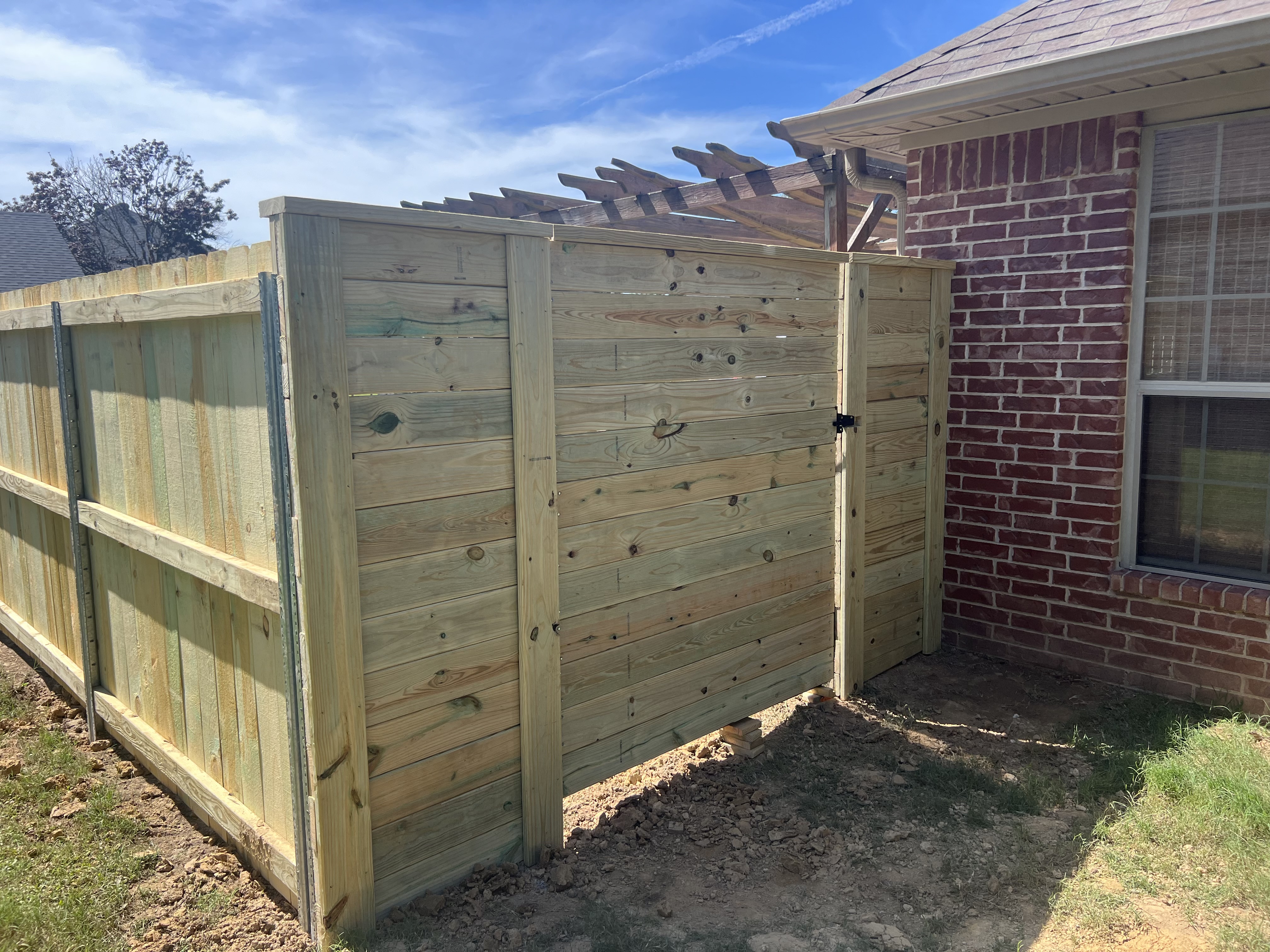
The photo here shows what custom usually means in practice. A horizontal-board screen with a walk gate stands against a brick house, tucked under a wood pergola, while a vertical board fence on steel posts carries on to the left. Three different things meet within a few feet, and the job is making them read as one plan.
Horizontal boards change how a fence reads. The lines run with the house, so the screen looks more like part of the building than a property fence. They also show every flaw. A board that dips at one end is obvious with a whole stack of level ones above it, so the posts have to be plumb and the spacing has to hold from top to bottom.
Where a screen meets brick, we set a post of our own just off the wall and build from that, so the fence carries itself and the masonry stays untouched. Our custom fences service page covers the wider range of one-off builds we do around Central Arkansas.
Hiding the AC Unit, the Trash Carts and the Mower
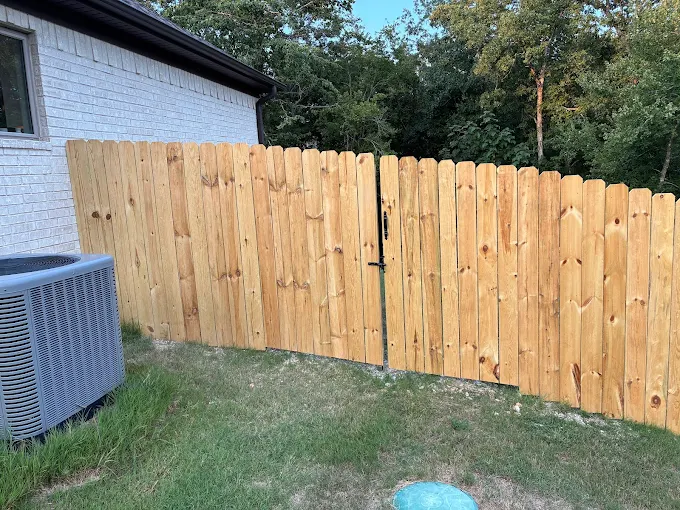
Every homestead has a corner nobody wants to look at, whether it is the condenser beside the back patio, the trash and recycling carts, or the mower and trailer parked by the shed. A short screen hides any of them without fencing the whole yard.
The details decide whether a screen works. An AC unit needs open air around it, so we leave room on every side and often gap the boards or hold the bottom off the ground so the unit can breathe. Carts need a wide opening on the side you roll them out, with nothing that catches a lid. An equipment corner needs space to back a trailer in without clipping a post.
Screens near the house get looked at every day, so they are worth building in the same board and finish as the rest of your fencing. If the corner you want hidden sits out by the drive, the gate half of that job is covered on our secure gating in Roland page, including hanging a wide gate so it does not sag.
When the Road Sits Higher Than the Yard
A fence of ordinary height assumes the neighbor and the road sit level with you. Around Roland that is often wrong. A house set below the road, or a yard that drops away beneath the place next door, can end up with a perfectly normal fence that still leaves the whole patio in view from every passing truck.
The answer is a custom height, but only where it is needed. We stand where you sit, look up at what you are trying to block, and work out how tall the fence has to be at that spot. Sometimes that means one taller section by the patio and normal height everywhere else. Sometimes the top steps up along the stretch that faces the road.
Height is also where the county comes in, since unincorporated Pulaski County can limit height and setbacks by zoning. A tall screen on the road side may need to sit farther back than you first pictured, and we check that before promising you a number.
Mixing Fence Types on One Property
Roland lots are big enough that one fence rarely suits the whole thing. Up close you want privacy. At the edges you want a boundary that stays out of the view. Somewhere in between there might be a dog run, a garden, or a gate across the drive. Owners who plan all of it at once end up with fences that look like they belong to the same property.
Planning it together lets the pieces agree. Post tops can line up where two styles meet. The finish on a wood screen can match the gate beside it. Each fence ends at its own post, so the heavier one never hangs off the lighter one, and the changes in style land at a corner or a gate.
For the outer boundary, our ranch fencing in Roland page covers X-rail and split-rail. A section of black aluminum fencing is a common middle choice around a garden or a pool yard, and the dogs can get a vinyl-coated chain link enclosure from our dog kennel fences page, tucked behind the house where nobody has to look at it.
Screws, American Lumber and One-Off Builds
A one-off build has no catalog panel to fall back on, so it lives or dies on material and fastening. We build with American-sourced lumber and fasten with screws, never staples. On a fence that is mostly about looks, that matters more than usual, because a stapled board can cup and pull away over a few seasons, and on horizontal boards one cupped board breaks the line for everybody.
Screws hold boards flat. They also let us take a board off and put the same one back if something behind the fence needs work later, like a technician reaching the AC lines or someone getting at a hose bib. That is a real advantage on a screen built around equipment.
If a regular privacy run does the same work as the elaborate version you had in mind, we will say so.
On Every Custom Build
- Posts set in concrete, including the short posts behind an equipment screen
- American-sourced lumber fastened with screws, never staples
- Clearance around AC units, and room to roll carts and back trailers in
- Height worked out from where you sit, then checked against county limits
Finished work is in our fence gallery. If you already have a spot in mind, send us the address and a photo of the corner.
Custom Build Questions We Get in Roland
How close to an AC unit can a screen go?
Close enough to hide it, with enough space left for air to move and for a technician to work. We leave room on every side and usually gap the boards or lift the bottom so the unit breathes. Your unit’s manual lists its own clearances, and we build to those.
Can a fence attach to my brick wall or pergola?
It can meet them cleanly. Beside brick we usually set our own post rather than drilling into the masonry, and we tie into a pergola post only where the structure is sound enough to carry it. Either way, the fence holds its own weight and the house never takes the strain.
Can you mix wood boards with steel posts?
Yes. Wood boards on steel posts is a common pairing, and the photo on this page shows one running past the horizontal screen. We talk through which posts make sense for your build on the walk, since each has its place depending on how the fence will be used and seen.
How much gap should a screen leave between boards?
It depends on what the screen is for. Around an AC unit we gap the boards so air keeps moving. Along a patio we keep them tight so the screen hides what it is meant to hide. One screen can do both, with the spacing changing at a post.
Do you build gates into horizontal fences?
Yes. A walk gate in a horizontal screen is built so its boards line up with the fence on both sides once it is closed. That takes a stiff frame, since a wide gate with long boards will sag without one, plus careful spacing so the lines carry straight across.
Why screws instead of staples?
Screws hold each board tight to the rails, so the boards stay flat instead of working loose as the seasons change. They also come out cleanly. If something behind a screen ever needs service, we can remove a few boards and put the very same boards back.
Homesteads Out Toward Natural Steps
Custom work around Roland usually happens on homesteads with room to spread out, where the house, the shop, and the equipment each want a different kind of fence. If that sounds like your place, call (501) 626-7024, or start from our Roland page to see what else we build nearby.
Roland Fence Work Beyond Custom Builds
Bring Us the Awkward Corner
Send the address and a couple of photos of the spot you want screened, or the place where a fence has to meet the house. On the free on-site visit we measure, look at what you are hiding and from where, and talk through materials. You then get a written quote that names the boards, the posts, and the fasteners. We are licensed, insured, and bonded.
(501) 626-7024 kadeendl@gmail.com Send a photo of the corner