Getting Roland Acreage Ready for Fence Layout Day
The short version: Most of a long rail fence gets decided before the crew digs a single hole. Pull out your plat or survey, find the corner pins, clear a walking path along the line, and decide where the tractor and trailer will cross. Then we walk the whole run with you, string in hand, and nothing gets dug until you have seen the line staked out on the ground.
The day the crew pulls in with the auger is the loud part of a rail fence job. The day that decides whether the fence lands where you wanted it comes earlier, and on Roland acreage it usually involves a folder of closing papers, a good pair of boots and a lot of tall grass. Owners who sort out a few things before we arrive end up with a straighter line, a quicker build and fewer surprises once the posts start going in. None of it takes special tools. It takes a weekend afternoon walking the property with the paperwork in your hand.
What the Plat Shows Before Anyone Walks the Line
If you bought acreage around Roland, there is a good chance a plat or a survey came with the closing papers. Dig it out. It shows the length of each side, the angles at the corners and any easements crossing the property. Easements matter for a fence. A utility or access easement can limit what you build on that strip, and it is far easier to route the line around one on paper than to move posts after they are set.
The plat also tells you which corners you are hunting for. Mark them on a copy, along with anything you already know about the ground: the low spot that holds water after a storm, the stretch where the mower always hits rock, the old wire fence that may or may not sit on the line. Bring that copy to the walk. We lay the run off the survey, and your notes save time finding the trouble spots.
If there is no survey and the line is in doubt, settle it with the neighbor or a surveyor first. A rail fence a few feet over the line is a long fence to move.
Finding Corner Pins in Tall Grass
On rural land, the corners are usually marked with iron pins driven into the ground, sometimes topped with a plastic cap stamped by the surveyor. Over the years they get buried, mowed over, bent by a tractor tire or swallowed by brush. Plenty of Roland owners have never seen theirs.
Start where the plat says the corner should be and look for a short rod sticking up an inch or so, or a faded piece of flagging tied to something nearby. A metal detector from the hardware store helps a lot, since a pin is often a few inches under the dirt. Once you find one, drive a stake beside it and tie bright tape to the stake so the pin does not disappear again before layout day.
If a pin is missing, call the surveyor whose name is on the plat. Having one corner reset is a small job next to moving a finished fence, and with all the corners marked we can pull a string between them and trust what it tells us.
Clearing a Path Before the Crew Pulls In
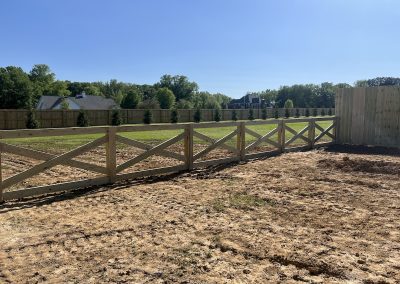
A rail fence along a tree line or through old pasture needs a clear strip to work in. The crew has to walk the string, carry posts and rails, and run an auger at every hole. Vines, brambles and saplings in that strip slow down every one of those jobs.
Plan on clearing a path a few feet wide along the whole run, a little wider where the line passes close to trees. Cut saplings off low so the stubs do not trip anyone or push up through the rails a year from now. Mow the tall grass so a stake or a pin is easy to spot. Pile the cut brush well off the line and away from where the trailer will park.
Big trees on the line are a different call. Leave them standing and tell us which ones you want to keep, and we will plan the fence around them on the walk. If a buried water line or electric run crosses the property to a shop, a well or a barn, flag where it goes so the crew knows to dig clear of it.
Openings for the Tractor and the Trailer
A boundary fence closes off whatever used to cross it. Before layout day, think through everything that moves around the property over a year: the tractor and the bush hog, the truck pulling a trailer to the barn, hay coming in, a neighbor who cuts the back field for you. Each of those needs a way through.
Look for the worn tracks in the grass, since those show where people really drive. Put the opening on a track that already exists and it gets used without anyone thinking about it. Then picture the longest rig turning through it, because a trailer swings wider than the truck in front of it.
The gate itself can wait if it has to. A properly sized gap with heavy posts on each side lets you hang a gate later, and our Roland drive gate page covers how we hang the wide ones.
What Happens on Layout Day
Layout day is a walk. Kade or one of the crew starts at a corner pin, stretches a string to the next one, and you walk it with us. Every turn, every opening and every tree the line has to pass gets settled while you are standing there looking at it.
Post spots get marked off the string, so before a hole is dug you can see the fence on the ground as a row of stakes or paint marks. Stand at one end and sight down it. If something looks off from the porch or from the road, that is the moment to move it. Where the ground rolls, we decide stretch by stretch whether the rails follow the slope or step down at the posts.
Our ranch fencing work in Roland covers the X-rail and split-rail we build on these lines, and the Roland fence company page covers the rest of what we do out here. Every post on the run goes in concrete, and the lumber is American-sourced.
Layout Questions From Roland Landowners
Should I be there on layout day?
If you can, yes. It is the one point in the job where moving the fence takes nothing but a few stakes. You know where the tractor crosses, which trees matter and how the line looks from the house. If you cannot be there, walk the staked line before digging starts and call us with anything you want changed.
What if my neighbor and I disagree about the line?
Settle it before we build. A survey is the usual answer, since it gives both of you the same pins to point at, and a surveyor’s stake ends the argument faster than either of you can. Once the line is agreed on, we lay the fence off it and the two of you never have to revisit it.
How much brush do I need to clear before you come?
Enough for the crew to walk the string and run an auger at each post, which usually means a strip a few feet wide along the whole run. Cut saplings low, mow the tall grass so stakes stay visible, and pile the brush well away from the line. Tell us about any trees on the line you want to keep.
Start With the Folder From Your Closing
Find the plat, find the pins and mow a path. Then send us your address, and Kade or one of the crew will set a time to walk the line with you.
Ready to Mark Out the Line?
Tell us roughly where the corners sit and where the tractor needs to cross. We will walk the run with you, stake it out and put a written quote in your hands for the whole line.
Call Kade (501) 626-7024 Have Kade walk the line