Skip to content

Jacksonville Wood Fences

Jacksonville Wood Fencing

Jacksonville Wood Fence Installation

A lot of the yards we fence around here belong to families who did not pick the move and cannot pick the date. Delta Fence builds wood privacy and picket runs on a schedule you can plan around, with posts in concrete and boards on screws. Licensed, insured, bonded.

Choosing the Wood

Arkansas Humidity Decides More Than Your Budget Does

People usually open the conversation with a species already in mind, and most of the time it came from a neighbor whose fence has been up two years. Two years does not tell you much. What tells you is how the wood behaves after five summers of the air we get here, where a board can be soaked at seven in the morning and baking by two in the afternoon. That swing is what moves lumber, and moving lumber is what makes a fence look tired long before it is actually worn out.

Cedar takes the swing better than anything else in the normal price range. It stays flatter, it fights rot and bugs without a homeowner doing anything on a schedule, and it keeps a straighter top line when the humidity climbs. Treated pine is the value pick and there is nothing wrong with it, but you buy that savings with upkeep: it wants a sealer put back on it every couple of years or it will cup and check on you. Cypress is the nicest grain of the three and it costs what nice grain costs.

We would rather tell you which one fits how you actually live than sell you up. If you are the kind of homeowner who will never get around to sealing anything, say so and we will point you at cedar and be done with it.
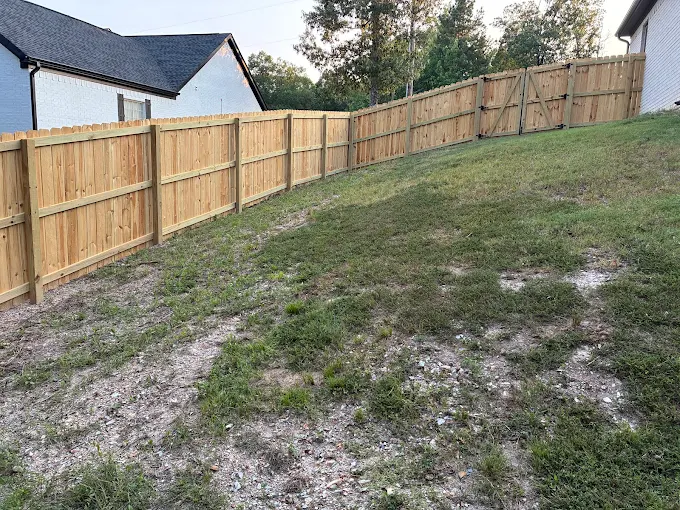
Dog-ear pressure-treated pine privacy fence with a double gate on a sloping back yard in Jacksonville, AR
Below Grade

What Goes In the Hole Under a Pulaski County Yard

A wood fence fails from the bottom. Almost nobody looks there, because the part you see is the part that looks finished, but the hole is where the job is decided. Pulaski County ground holds water, and water held against a post is the whole problem in one sentence. It rots the wood at the collar, and when the ground swells wet and shrinks back dry it walks the footing until the run has a lean in it that no amount of tightening boards will fix.

So our holes go past the frost line and get belled out toward the base, wider down low than up top, and then they get filled with concrete. That bell is doing more work than the depth number is. A footing shaped like that has to be dragged through soil to move, where a straight column can simply be pushed up by ground that swells. We finish the pour with a slope on it so rain sheds off the concrete rather than collecting in a ring against the post, and in a yard that drains slow we bed the bottom in clean gravel before anything else goes in.

None of that is exotic. It is a few extra minutes a hole and a bag of gravel, and it is the difference between a fence you forget about and one you are propping up in year four.

Scheduling

Building Around Orders That Move Without Warning

A lot of our work in this town comes from families connected to Little Rock Air Force Base, and that changes how we schedule more than it changes how we build. Somebody calls with a report date on one end and a closing on the other, and the fence has to land in between. Sometimes it is going up so the dog and the kids have a safe yard the week the truck unloads. Sometimes it is going up because the house is about to go on the market and a bare back line is the thing holding up the listing photos.

Either way, the honest answer up front is worth more than an optimistic one. When we walk your line we tell you what the calendar actually looks like, including material lead time, and if we cannot hit your date we say that instead of booking you and hoping. A residential wood run is usually a one to three day build once we start, so the date that matters is the start date, and we do not move it on you after we have given it.

If your window is tight, call it out on the first phone call. We will tell you straight whether it works.

After the Build

Keeping the Finish On a Fence You May Not Own for Long

The most common mistake with a new wood fence is finishing it too soon. Fresh lumber is still carrying moisture, and a stain rolled onto damp wood will not bond. It sits on the surface, looks great through the summer, and starts flaking off in sheets by the time the weather turns. We would rather you skip a finish entirely than pay for one that peels.

So we let the wood dry and settle for a few weeks after the build, then it is ready to seal. A semi transparent stain is the one we point most people toward, because it lets the grain show and slows down the graying that our sun puts on bare wood in a couple of seasons. After that, a rinse and a fresh coat every few years on pine, less often on cedar, keeps it where you want it.

If you are looking at a move in the next year or two and the upkeep is the sticking point rather than the look, we will say so and talk you through the alternatives before you commit to wood at all.

■

Capped Posts

Rain sitting on cut end grain is where a lot of older fences rot from first. Every post we set gets a cap so the top is not drinking.

■

Room to Move

Boards get spaced with expansion in mind. Wood swells in a wet July, and pickets butted tight against each other will buckle when it does.

■

Screws, Never Staples

A screw holds its grip season after season, and one board can be backed out and replaced without disturbing the run beside it. Staples let go.

Style

Solid Privacy or an Open Picket Line

Most of the wood we put in around here is six foot privacy in the back and something lower and more open out front, and the reason is simple: those two parts of a yard are doing different jobs. The back is where the dog runs and the kids play, and that wants a solid line with no gaps at the bottom and nothing a hand can reach through the gate to work loose. Board on board and shadowbox both get you there, and shadowbox has the advantage of looking finished from your neighbor’s side too, which matters on a street where the houses sit close.

Out front, a picket is doing something else. It marks the line, it keeps a small dog in the yard, and it does not wall off a house that most people want to look open and kept. A picket run also lets air move through it, which on a humid stretch is not a small thing for the wood itself.

We build both, and we will lay out which sections of your property want which before you sign anything. If a full solid line is what you are after, our Jacksonville privacy fence page covers that side of the work in more detail, and the full material rundown lives on our wood fencing service page.

FAQ

What Jacksonville Homeowners Ask Us About Wood

Cedar or treated pine for a back yard here?

Cedar if you would rather not think about the fence again. It handles our humidity on its own and stays flatter. Treated pine costs less and holds up fine, but it wants a sealer put back on it every couple of years to stay that way. Tell us honestly whether you will do that.

We report in six weeks. Can you get a fence up before then?

Usually, and we will tell you on the first call rather than after you have waited. The build itself runs one to three days. What sets the date is material lead time and where you land in the schedule, so the sooner you call the more room we both have.

How deep do the posts go?

Past the frost line, set in concrete, with the hole belled out at the base so the footing has something to bear against. A number on a tape measure is only part of it. The flare and the crowned pour are what stop a post from walking.

Should we stain it right after you finish?

No. New lumber is too wet to bond with stain, and a coat put on early peels within the year. Give it a few weeks to dry and settle, then seal it.

Do you take down the fence that is already there?

That is part of the job. Teardown, loading, hauling, and a swept line ready for the auger, all before we set anything. Older lots around town almost always have buried footings from the last fence, and we dig those out rather than work around them.

Are you licensed and insured?

Licensed, insured, and bonded, and we will show you the paperwork without you having to ask twice. The lumber is American sourced. Send us your details and Kade will come walk the line with you.

Service Area

Working Jacksonville and the 67/167 Corridor

We build across Jacksonville, from the streets around Dupree Park out along the Highway 67/167 corridor, and we cover the stretch of Pulaski County that runs between Little Rock and Cabot. Finished work is in our fence gallery, and the rest of the city is covered on our Jacksonville fencing page.

Related Services

Other Fencing We Build in Jacksonville

Jacksonville Vinyl Fencing

Nothing to seal and nothing to stain, which suits a household that would rather not add another chore to the list.

See More →

Jacksonville Chain Link

Galvanized and vinyl coated runs for back yards, side lots, and anywhere the view matters more than the screening.

See More →

Jacksonville Commercial Fencing

Perimeter and access work for shops, yards, and job sites along the corridor through town.

See More →
Next Step

Walk Your Line With Kade Before You Commit to Anything

He will look at how your yard drains, talk through cedar against pine, and give you a straight quote with a real start date on it. If the timeline does not work, he will tell you that instead of taking the job. We are licensed, bonded, insured, and the lumber comes from American mills.

(501) 626-7024 kadeendl@gmail.com Map My Fence Line