Fencing a Sherwood Back Yard for a Dog: Four Ways They Get Out
Quick Answer: A dog leaves a fenced yard four ways: over the top, under the bottom, through the fence itself, or out the gate. Each one has a different fix, and buying a taller fence when you have a digger or a gate problem is money spent on the wrong end. Figure out which one your dog is before you pick a fence.
Almost every dog fence call we take in Sherwood starts the same way. The dog got out, and the owner wants a taller fence. Sometimes that is the answer. More often the dog never went over anything, it went under the back corner where the yard slopes, or it leaned on a gate whose latch had worked loose over a couple of summers. Height would not have changed a thing.
So we ask a different question on the walkthrough. How does your dog get out. Answer that and the fence mostly picks itself. Here is how the four failure modes look on a real Sherwood lot, and what actually holds against each one.
Start With How the Dog Escapes
Over, under, through, and the gate. That is the whole list, and they call for different work. Over is a jumper or a climber, and it points at height, at what the dog can get a foot on, and at what is stacked near the fence line. Under is a digger, and it points at the bottom of the fence and the ground it sits in. Through is a dog that pushes, chews, or drives at a weak panel, and it usually points at what the dog can see on the other side. The gate is its own category because gates move, and anything that moves eventually loosens.
If you do not know which one you have, look at the ground. Diggers leave the evidence in the dirt. Climbers scuff the fence and wear a track along it. Fence-runners kill the grass in a straight line down the whole run. The yard tells you before the dog does.
Under: What Actually Stops a Digger
Central Arkansas clay is dense and it holds a hole. A determined dog will find the one spot where the ground falls away, usually a low corner or the run where water sheds after a storm, and go to work there. Sherwood yards from the seventies and eighties tend to be big and flat with mature trees, and those old root systems leave soft pockets and gaps along a fence line that a dog will find long before you do.
Three fixes work, and they are all about the bottom of the fence rather than the top. The first is burying the fabric or the pickets below grade so there is nothing to scrape at. The second is a concrete or gravel mow strip, a narrow band poured or set along the fence line that the dog cannot dig through and that keeps a trimmer off your pickets as a bonus. The third is an L-footer, which is fencing material turned ninety degrees and laid flat along the ground on the inside of the fence, then pinned down and grown over. The dog paws at the ground, hits wire, and quits. It looks like nothing after a season of grass.
Which one we recommend depends on the yard. Mow strips make sense on a long straight run you are already tired of trimming. Buried fabric is the cleaner answer when we are putting the fence in new. L-footers are the practical retrofit when the fence is fine and only the bottom edge is the problem.
Over: Height Is Usually the Wrong Lever
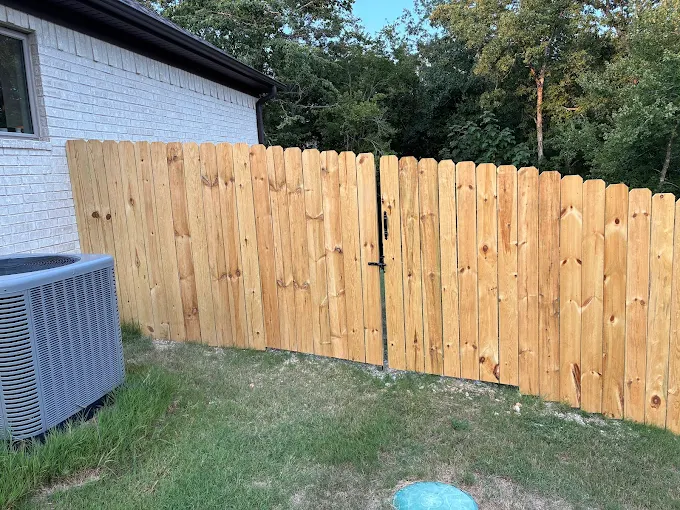
A jumper and a climber are two different animals. A jumper leaves from the ground, and for most breeds a six foot fence ends that conversation. A climber uses the fence, and height barely matters to it. Chain link is a ladder to a climbing dog because every diamond is a foothold. Go from four feet to six and a climber just takes an extra second.
What works on a climber is removing the grip and the launch pad. A solid wood or vinyl fence with a flat face gives nothing to hook a paw into. Keeping the yard side clear matters just as much, because a woodpile, an AC unit, a trash cart, a raised bed, or a low limb next to the fence takes two feet off the height without anyone deciding to. We walk the fence line and note every one of those before we spec anything.
Rails matter too. On a wood fence, putting the horizontal rails on the outside instead of the yard side removes the built-in steps most climbers use. Small detail, and it settles a lot of dogs on its own.
Through: What the Dog Can See Changes the Dog
This is the one people do not expect. A dog that can see the street, the sidewalk, the mail carrier, and every other dog walking past is going to react to all of it. Chain link is honest about this. It contains the dog perfectly and screens nothing, so the dog spends the day watching traffic and barking at it, then running the fence line, then hitting the fence. That is a behavior problem the fence is feeding, and no gauge of wire fixes it.
Taking away the sightline settles a lot of dogs. A solid privacy fence removes the trigger, the barking drops, and the fence-running usually goes with it. It is the strongest argument we know for choosing wood or vinyl over wire on a dog yard, and it has nothing to do with strength. If the yard is quiet and backs up to woods or another yard rather than a street, chain link may be entirely right, and it costs less and lasts a long time. Both are honest options. Compare chain link fences in Sherwood against privacy fences in Sherwood with your specific dog in mind rather than the general idea of a dog.
The Gate Fails Before the Fence Does
Nine times out of ten the escape point is the gate, and nobody suspects it because the fence looks fine. Gates are the only part of the run that moves. Hinges sag, the frame goes out of square, the latch stops catching cleanly, and the gap under the leaf grows as the ground settles. Then one afternoon the gate looks shut and it is not.
What we do about it: heavier hinges than a gate that size strictly needs, a diagonal brace or a welded steel frame so the leaf cannot rack, a latch that a paw or a nose cannot lift, and a drop rod on a double gate so the leaves cannot be pushed apart in the middle. We also close the gap under the gate, because a dog that will not dig will still walk right under a leaf hung two inches high.
If people come and go through that gate, add a spring closer or a self-latching mechanism. Most gate escapes are not the dog beating the hardware, they are a gate that got left ajar by somebody in a hurry.
Big Dogs: Frame Diameter Beats Everything Else
For a large, strong dog, the failure is usually structural. Posts loosen, gate frames rack, and light wire deforms where the dog leans on it every day. Heavier posts set deep in concrete, a real top rail so the fence has a spine, thicker gauge fabric on a chain link run, and a welded rather than bolted gate frame are what survive that kind of daily load. Wood holds fine for big dogs as long as the posts and rails are sized for it and the pickets are fastened properly.
None of that is exotic, it is just a step up in material at four or five specific points. Skipping it is why some dog fences look tired after two winters while the same fence on the next street still stands tight.
Before You Replace: Check What You Already Have
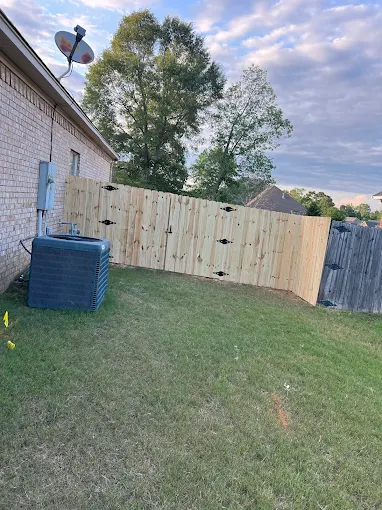
Plenty of Sherwood fences do not need replacing. Walk the run and check a short list. Push on the posts, since a post that rocks is a post that needs resetting. Look for daylight under the bottom edge, especially at corners and where the yard drains. Swing the gate and watch whether the latch catches on its own. Check for rot at ground level on older wood and for pickets that have worked loose at the bottom fastener. Note anything stacked along the fence that a dog can climb.
If the posts are sound and the line is straight, most dog problems can be fixed in place with an L-footer, a gate rebuild, a bottom rail, or a run of pickets. If the posts are moving, the fence is telling you something bigger, and patching it is going to be a recurring chore. Fence height, placement near the street, and what is allowed on your parcel are questions for the City of Sherwood, Pulaski County, and your neighborhood association, so check with them before you settle on a plan.
Tell Us About the Dog
Tell us the breed, the size, whether it digs or climbs, and where it got out last time. That conversation changes what we build more than the lot dimensions do. See the rest of what we do across Sherwood, or reach out and we will come look at the yard.
Get a Free Fence Quote
Delta Fence LLC serves Sherwood and central Arkansas. Licensed, insured, and bonded.
Call (501) 626-7024 Get a QuoteFrequently Asked Questions
What fence height do I need for a dog in Sherwood?
Six feet stops most jumpers, but height does nothing for a climber or a digger. Identify how your dog actually gets out first. Allowable heights are set by the City of Sherwood and, where one applies, your neighborhood association.
How do I keep my dog from digging under the fence?
Bury the fabric or pickets below grade, run a concrete or gravel mow strip along the fence line, or add an L-footer, which is fencing laid flat on the ground inside the fence and pinned down. All three work on central Arkansas clay.
Is chain link or a privacy fence better for a dog?
Chain link contains a dog fine and costs less. If your dog barks at everything it can see, a solid wood or vinyl fence removes the trigger and usually settles the barking and fence-running. It depends on the dog and what the yard faces.
Why does my dog keep getting out of the gate?
Gates move, so they loosen first. Sagging hinges, a racked frame, a latch that no longer catches, and a gap under the leaf are the usual culprits. Heavier hinges, a braced frame, a self-latching mechanism, and closing the bottom gap fix most of it.
Can you fix my existing fence instead of replacing it?
Often, yes. If the posts are solid and the line is straight, an L-footer, a gate rebuild, or replacement pickets usually solve a dog problem. If posts are rocking in the ground, we will walk you through what a rebuild would involve.