Talking to the Neighbor Before You Build a Privacy Fence
The short version: A privacy fence is the one home improvement that changes what somebody else looks at every day. Ten minutes of conversation before the crew arrives prevents almost every problem that comes up afterward, and on the close-set lots around this town it occasionally turns into a shared job that costs both households less.
Nobody puts up a six-foot fence to annoy the people next door. It still happens, because a solid wall of cedar going up along a shared line is a visible change that arrives without warning if the first the neighbor hears about it is an auger running at seven in the morning. Around Jacksonville, where houses on the older streets sit close and yards look into each other, this comes up more than any other non-technical question we field.
Why the Conversation Is Worth Ten Minutes
Here is what usually goes wrong. Somebody decides on a fence, signs, and the first their neighbor knows about it is a truck in the driveway. The neighbor is not upset about the fence. They are upset about finding out from a stranger holding a post hole digger. That reaction then attaches itself to every detail of the project: the height, the side the frame faces, whether a post is three inches over the line, whether the crew stepped on their grass.
If instead you knock on the door a week out and say you are putting in a privacy fence, here is roughly where it runs, here is how tall, the whole thing usually ends in about four minutes with a shrug. Occasionally it ends better than that. Jobs sometimes grow because the neighbor says they had been meaning to do the same thing and asked whether we could quote the two runs together, which saves both households a mobilization and puts one continuous fence on the line instead of two that do not quite match.
You are not asking permission. On your own property with a code-compliant fence you do not need any. You are just making sure the first conversation about it happens on your terms rather than through a window.
Finding the Line Before Anybody Digs
Most neighbor disputes over a fence trace back to a fence that was built without anybody actually locating the property line. Somebody assumes the old fence was on the line, or that the line runs where a row of shrubs happens to be, and years later a survey says otherwise. At that point moving the fence is the cheap outcome.
We find the line before the first hole gets dug, and we set the posts just inside it so the entire run sits on your ground. That has a practical consequence people like: a fence wholly on your property is yours to maintain, modify, or take down without needing anybody’s agreement. It also means nobody can claim a piece of it later. Where an old fence already exists, we do not assume it was in the right place. Old fences wander, especially the ones that have been rebuilt in place two or three times over the decades.
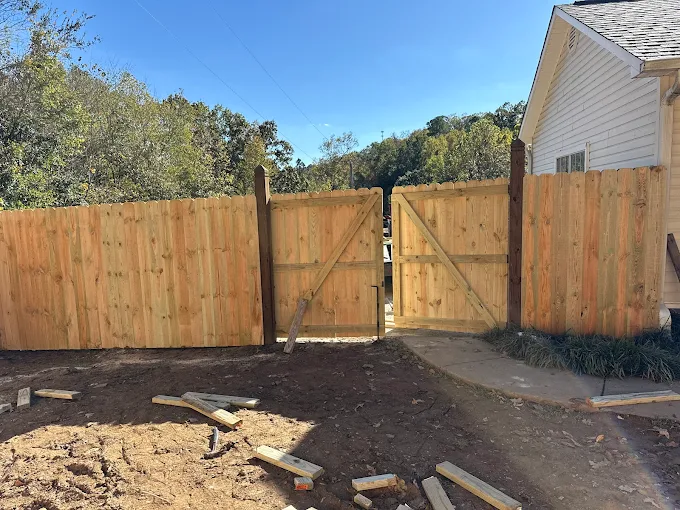
Ten minutes with a tape and the plat is not a big investment. It is the single thing most likely to keep a fence from becoming a conversation you have to have twice.
Which Side Faces Out and Why It Matters Here
On a fence with pickets fastened to rails, one side shows the smooth face and the other shows the framing. Custom around here, and in most of the country, puts the finished face outward toward the neighbor and the street. That is not a rule anybody enforces on a typical residential lot, but going against it is noticed immediately by everyone who has to look at it.
There is a build that removes the question entirely. Board-on-board overlaps the pickets, which means the rails are hidden and the fence looks the same standing in either yard. On the tighter lots in this part of Pulaski County, where the fence is often the only thing between two back doors, that is worth what it costs. Nobody gets the good side and nobody gets the frame, so the whole discussion stops before it starts.
Where the yards are big enough that your neighbor is not staring at the fence from twenty feet away, a standard build with the smooth face out is perfectly fine, and it stretches your money further down a long run. We will lay out both when we walk the line so you can decide based on what your particular lot looks like rather than a general rule.
Height, Gates, and the Things Neighbors Actually Notice
Six feet is the working standard for privacy in a back yard, and it is the height that does the job: it stops sightlines from a standing adult in the next yard and it is beyond what most dogs will attempt. What neighbors notice is not usually the height itself. It is where a tall run starts and stops. A six-foot wall that continues forward past the front corner of the house changes the look of the street and is the thing most likely to draw a comment or a code question.
The other detail worth thinking about is the gate. If your neighbor has been cutting across the back corner of your yard to get to a shed or an alley for fifteen years, a fence ends that habit overnight. Sometimes people want that. Sometimes they had not thought about it, and a gate in the right spot costs very little and keeps a good relationship intact. That is exactly the kind of thing that surfaces during a walkthrough and never surfaces on a phone call.
Drainage falls in the same category. A solid fence built tight to the ground across a swale will hold water back and put it somewhere it did not used to go, which is often a neighbor’s low spot. We look at how the yard sheds water before we decide how the bottom of the run gets treated.
When the Neighbor Wants In on the Job
A fair number of the privacy fences we build off the Highway 67/167 corridor started as one homeowner calling us and turned into two once the neighbor saw the truck. If that is a possibility on your street, it is worth mentioning to us early. Quoting two adjoining runs at once is straightforward, and building them in one trip is more efficient than coming back in six months.
If a neighbor wants to split the cost of the shared run itself, that is a private arrangement between the two of you and we would suggest putting whatever you agree to in writing, however informally. It is not a legal formality so much as a memory aid. Households in this town turn over, and an understanding that lived only in a driveway conversation does not survive the next owner.
Whatever you land on, we can put the scope on paper broken out by section so both parties can see exactly what is going where. Full detail on how we build solid runs is on our Jacksonville privacy fence page. If you want the same screening without any upkeep, the vinyl option is worth a look, and the material comparison is on the wood fence page.
Questions About Fences and Neighbors
Do I need my neighbor’s permission to build a privacy fence?
Not on your own property, as long as the fence meets city requirements for height and placement. Permission is a different thing from courtesy, though. Telling them a week ahead of the build costs you nothing and removes the surprise, which is what most complaints are actually about.
Which side of the fence should face my neighbor?
Custom puts the smooth finished face outward, toward the neighbor and the street, with the framing on your side. If that bothers you, board-on-board looks identical from both yards and takes the question off the table entirely. We will show you both during the walk.
What if my neighbor wants to share the fence and the cost?
That happens often here, and we are glad to quote the runs together since building both in one trip is more efficient. Put whatever the two of you agree on in writing. Houses in this town change hands, and a driveway handshake does not carry over to the next owner.
Build It Once, Keep the Street Friendly
A privacy fence should make your back yard feel like yours without making the person next door feel walled off without notice. Locate the line, mention it early, put the good face out or build one that has two, and the fence goes up without becoming a story anybody tells later.
Walk the Line With Kade
Delta Fence LLC builds privacy runs across Jacksonville and Pulaski County. We carry the license, the insurance and the bond, and every post goes in concrete.
Call Kade (501) 626-7024 Map My Fence Line