Building a Jacksonville Wood Fence You Will Hand to Somebody Else
The short version: A lot of houses in this town change hands on somebody else’s schedule. That does not mean you should build a cheaper fence. It means you should build one that keeps looking cared for with nobody standing over it, because the person walking the back yard two years from now may be an appraiser, a renter, or a buyer with a checklist.
Ask around Jacksonville and you will hear the same thing from anybody tied to Little Rock Air Force Base: the house is yours right up until orders say otherwise. That reality shows up in fence conversations more here than anywhere else we work. People want to know whether it is worth building something good when the ownership window might be short, and whether there is a version of a wood fence that does not punish them for leaving. There is, and it has almost nothing to do with spending less.
The Difference Between Cheap and Short-Term
Homeowners planning a possible move often ask for the least expensive fence on the theory that they will not be around long enough to care. That logic falls apart the second the house goes on the market. A sagging run, a gate somebody has to lift, gray boards curling at the ends: those are the details a buyer’s eye lands on when they step out the back door, and they read as a house that was let go. A fence is one of the few improvements that a stranger evaluates in about four seconds without knowing anything about how it was built.
What actually shortens the timeline on a wood fence is not the grade of the boards. It is the parts nobody photographs. A run built with the posts set properly and the boards fastened with screws will still be square and tight after the years you spend in the house and the years the next family spends there. A run built fast with staples and shallow posts starts telling on itself in about eighteen months, which is exactly the window a lot of assignments cover. You can spend less and still get a fence that outlives your time in the house. What you cannot do is skip the ground work and expect the thing to hold its line.
So when we walk a yard with somebody who is thinking about the resale side of this, we do not steer them toward thinner material. We steer them toward the build that keeps its shape without supervision.
What a Fence Says About a House From the Back Door
Realtors talk about curb appeal, which is a front yard idea. Fences do their work on the other side of the house, in the ten seconds somebody spends standing on the patio deciding whether the yard is usable. A straight top line reads as a property that was maintained. A wave in that line reads as deferred work, and once a buyer starts adding items to that list, everything else in the yard gets a harder look.
The specific things that register are simple. Does the gate close by itself or does it need a shove and a lift. Is the bottom of the fence sitting evenly against the ground or is there a gap somebody’s dog is going to find. Do the posts stand plumb when you sight down the run from the corner. None of those depend on the wood being expensive. All of them depend on whether the crew took the extra ten minutes per hole and used fasteners that hold.
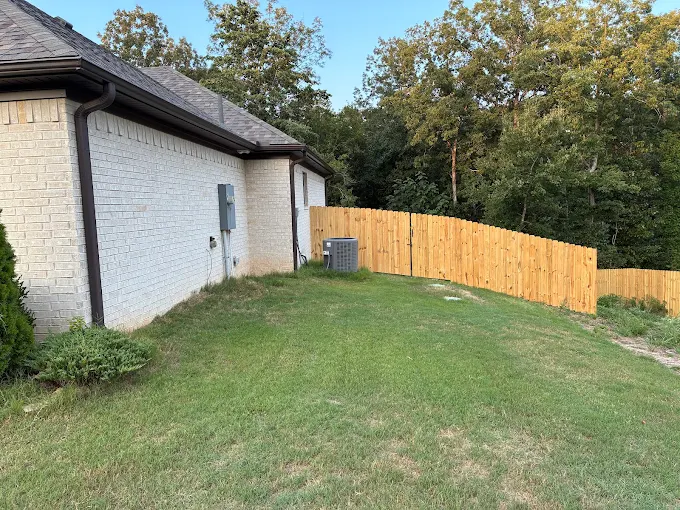
There is a practical benefit while you are still living there, too. A fence that stays tight is a fence you never think about, which is worth something when the household is already juggling a move, a new school, and a job that does not care about your weekend plans.
Choosing Boards With Somebody Else’s Upkeep in Mind
Wood asks for attention. How much attention depends on what you build with, and that decision looks different when you know the next owner may not be the type to keep up with it. Treated pine is the value option and it holds up genuinely well, but it wants a sealer put back on it on a cycle. If you will be here to do that, fine. If the house is going to a renter, or to a buyer you will never meet, you are handing over a chore that nobody signed up for and the fence will show it within a few seasons.
Cedar changes that math. It handles the humidity in this part of Arkansas on its own, without anybody rolling anything onto it, and it fades toward a soft gray rather than falling apart. If the fence goes untended for three years under an owner who never thought about it, cedar is still standing there looking intentional. That is a real advantage in a town where houses turn over as regularly as they do here.
There is a middle path we suggest fairly often: build the back run in cedar where the height and the exposure are, and use pine on a shorter side stretch that is easier to maintain and less visible. It keeps the money sensible without leaving the most exposed part of the fence dependent on a maintenance habit that may leave with you.
Removal, Old Footings, and the Fence Already There
Plenty of the wood work we do in Jacksonville is a replacement rather than a first fence. Older lots around town have had a fence line in the same place for decades, sometimes two or three fences deep, and what is buried along that line matters more than what is standing above it. Old concrete footings, broken-off posts, and buried wire all sit exactly where the new posts want to go.
We pull all of that out rather than working around it. A new post set six inches off the old line to dodge a chunk of buried concrete is how a run ends up with a bow in it that nobody can explain later. Digging out the old footings takes longer on day one and it is the reason the finished line is straight. We haul off the old material too, so there is no pile sitting in the side yard waiting for a trailer you were going to borrow.
If you are on a tight window before a listing or a closing, tell us that when you call. Removal adds time to the job, and we would rather build that into the schedule honestly than surprise you with it after the crew shows up.
How to Talk to Us When Your Calendar Is Not Yours
The most useful thing you can hand us on a first phone call is the date you are working against and what is on the other side of it. A report date, a closing, a tenant moving in, a family arriving with a dog in the back seat. Those are all different jobs even when the fence is identical, because they change what has to be finished first and what can wait.
We work the stretch of Pulaski County that runs between Little Rock and Cabot, so getting to a Jacksonville walkthrough is not a logistics problem for us and neither is coming back to handle a punch item. That matters when your window is measured in weeks. What we will not do is book a date we do not believe in. If your timeline is too tight for the material to land and the concrete to cure, you will hear that on the phone, not the week of.
Full material detail, cedar against pine against cypress, lives on our Jacksonville wood fence page. If you have decided you want a full solid line rather than something open, the privacy fence page covers that side of it, and the maintenance-free alternative is laid out on the vinyl page.
Questions We Hear About Building Before a Move
Is a wood fence worth it if we might sell in two years?
Generally yes, because a bare back line is one of the first things a buyer flags and one of the cheapest ways to make a yard read as finished. Build it properly rather than cheaply. A fence that is still square and tight when the sign goes up helps you. One that is already leaning works against you.
Should we stain the fence before we list the house?
Only if the wood has had time to dry out first. Stain rolled onto lumber that is still holding moisture will not bond, and a coat that starts peeling three months later looks worse than bare wood. If the fence is new and the listing is close, leave it and tell the buyer it is ready to finish.
Do you build fences for landlords who are not local?
We do that regularly around here, since plenty of Jacksonville houses get rented out after an assignment ends. Kade walks the property, sends the scope in writing, and keeps you updated by phone. If it has to be wood on a rental, cedar over pine, because nobody is going to stain it.
The Fence Outlasts the Assignment
You do not control how long you stay in a house in this town. You do control whether the fence around it is still doing its job when somebody else takes over. Build the part in the ground right, use wood that does not need babysitting, and it stops being a decision you have to revisit.
Have Kade Walk Your Jacksonville Yard
Delta Fence LLC builds across Jacksonville and Pulaski County. Licensed, insured, and bonded, with American-sourced lumber and posts set in concrete.
Call Kade (501) 626-7024 Map My Fence Line