A Business Gate From the Ground Up
The short version: Before an electric gate goes on a gravel business lot near Alcoa Road or Highway 183, look hard at the gate you already have, the ground the operator will sit on, the way water moves across the entrance, and whether the gate should hide the yard. Those decisions are far easier to make early than to undo once concrete is poured.
Most talk about commercial gates starts with the motor. On a working yard, the motor is usually the easy part. The trouble shows up in the frame that was never meant to be driven, the pad that sinks at one corner, the puddle that sits across the entrance after every storm, or the slats that turn a gate into a sail. This post works from the ground up, starting with the gate that may already be hanging at your entrance.
Refitting the Gate You Already Have
If your lot already has a chain link gate at the entrance that someone opens by hand every morning, the first question is whether that gate can be driven by an operator or whether it needs a new frame.
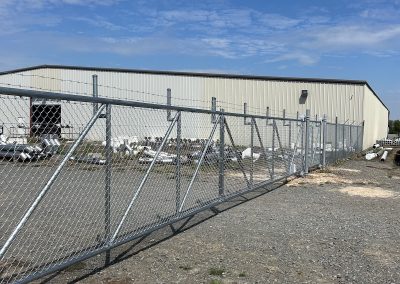
Look at the corners of the frame for cracked welds or bent joints, and sight down the top rail for a dip in the middle. A gate that has been dragged open and shut for years often sags at the free end, rubs on the gravel and has a brace or two pulled loose. Lift the free end and watch the hinge post. If the post moves, the gate is not the only problem.
A sound, square frame on solid posts can often take an operator with new hardware. A tired one is usually better replaced with a braced steel frame built for the job, hung on heavier posts set in concrete. We will look at yours and say which it is before anything is ordered.
The Concrete Pad Under the Operator
An operator sits beside the opening on its own concrete pad, and that pad does more work than it looks. It has to stay level so the operator stays lined up with the gate, it has to hold the anchor bolts tight against years of starts and stops, and it has to keep the unit up out of standing water.
On a gravel lot, the pad goes in on firm ground, not on top of loose rock. The gravel is cleared away down to a solid base, and the pad is formed and poured there. A pad set on gravel tends to tip as the stone shifts under it, and an operator that leans even slightly starts pulling the gate off its line.
Leave room around the pad. Gravel piled against the operator housing by plows, loaders or tires holds water against it and makes service harder. A clean edge of a few steps around the pad is worth keeping clear. Where the power reaches the pad is something to settle early, but that belongs to your electrician.
Keeping Water Off the Entrance
The entrance is often the lowest spot on a business lot, because every truck that ever turned in pressed it down a little more. After a heavy rain, water runs to that spot and sits there, right where the gate travels and the operator stands.
Standing water at the gate softens the ground under any wheel, washes gravel out of the travel path and leaves ruts that freeze or dry hard into ridges. A gate that clears the ground in July can catch on a ridge by February.
Before the pad is poured, look at where water goes in a storm. Regrading so the entrance sheds water toward the road ditch or a low corner of the lot, adding gravel to raise the area, or cutting a shallow swale along one side can each solve it. Our Bryant electric gate installation page covers the rest of how we set up a commercial gate and its operator.
Screening a Business Gate
Some lots want the yard out of sight from the road. Tools, equipment and stacked material sitting in plain view invite curiosity, and some owners simply want a cleaner front. A gate can be screened with privacy slats woven into the chain link or with boards fastened to a steel frame.
Screening changes the gate. A slatted or boarded gate catches wind the way open chain link does not, and the frame, the hinges or rollers and the operator all have to be sized for that load. A gate that was fine as open mesh can strain and stall once it is filled in.
Think about visibility from inside, too. Drivers pulling out like to see what is coming before the gate fully opens, and staff closing up at night like to see who is outside. On some lots the answer is screening the fence and leaving the gate more open, or screening the gate only partway up.
The First Months With a New Gate
A new gate settles in over its first season, and a little attention early keeps small things small. After the first big storm, walk the entrance and see whether water still finds its way to the pad or the travel path.
Rake gravel back from the pad edges and the gate’s path every so often, especially after equipment has been turning at the entrance. Pick up anything that has blown into the bottom of the fence near the gate, from plastic wrap to pallet scraps.
On a screened gate, check the slats or boards after a windy week and refasten any that have worked loose. Ask the people who use the gate every day whether it has started to sound or feel different, since they notice changes first.
Business Gate Questions From Bryant Lots
Do privacy slats make a gate harder on the operator?
Yes, because a screened gate catches wind that open chain link lets through. On a gusty day that load pushes back against the operator on every cycle. The frame, the hardware and the operator need to be sized with the screening in mind, so tell us early if you plan to add it later.
Can the operator pad be poured on top of our gravel?
We would not pour it there. Gravel shifts under load, and a pad sitting on it slowly tilts. We clear down to firm ground first and pour the pad on that, then bring the gravel back up around it so the lot surface still meets the pad cleanly.
Should a screened gate go all the way to the ground?
Usually not quite. A small gap at the bottom lets water and blown debris pass instead of piling against the gate, and it keeps the screening off wet gravel. How much gap depends on the lot and what you want hidden, which we work out with you on site.
Close the Lot Without Slowing the Work
A gate that opens for the right people and stays shut for everyone else changes how a lot runs. Contact us to look at your opening, and visit the Bryant fence company page for the rest of what we build locally.
Gating a Shop or Storage Yard?
Show us the opening, the gate you have now and where water sits after a storm. We will lay out the frame, the pad and any screening, and send a written quote.
Call Kade (501) 626-7024 Set up a lot walk