Skip to content

Alexander Secure Gating

Alexander has plenty of long drives, gravel yards and business lots where the gate matters more than the fence beside it. We build wide drive gates on galvanized steel frames, braced so they hold square, and hang them on posts set in concrete down in the clay. Whether the gate faces a shop yard or the end of a country driveway, we size it for the trucks and trailers that use it and fit the lock you will actually use every day.

Span

Sizing the Opening for a Truck and Trailer

The gate in this photo spans a gravel lot in front of a metal warehouse: a long galvanized frame with bracing running through it, stacked materials waiting behind. On an opening like that, width is the first thing we measure and the last thing anyone wants to get wrong.

A gate that fits a pickup can still pinch a pickup pulling a flatbed or a stock trailer, especially when the driver swings in off a road instead of driving straight at it. We watch how vehicles come in: which way they turn, how far the trailer cuts across the corner, whether a delivery truck ever needs through. On a longer rural driveway, setting the gate back from the road gives a driver room to pull fully off the pavement and stop before getting out to open it.

We would rather build a little wider than you think you need than watch a trailer fender clip a post the first month. Our secure gating page covers this work across Central Arkansas.
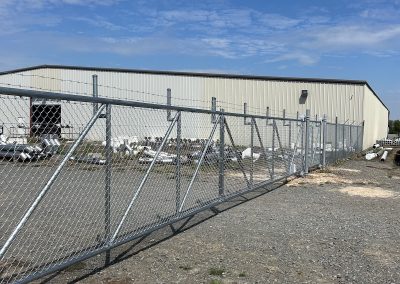
A galvanized chain link fence with a long braced gate frame across a gravel industrial lot, a metal warehouse and stacked materials behind it

A Frame That Holds Its Shape

A wide gate is a lever. All of its weight hangs off one side, and gravity spends every day pulling the latch end toward the ground. Wood frames give in to that sooner or later. Galvanized steel frames hold out far longer, and the brace is a big part of why.

We run a diagonal brace across each frame from the bottom hinge corner up toward the top of the latch end, so the frame pushes its weight back toward the hinge post instead of letting it hang. Long panels may get more than one brace or a center upright. Because the steel is galvanized, the frame holds up at its joints through wet seasons outdoors instead of rusting where the pieces meet.

A frame can be faced however the property calls for. Chain link fabric keeps a business yard visible from the road. Pine boards on a steel frame give a farm entrance or a privacy fence a matching gate that still hangs straight, like the double gate shown further down this page. The frame does the work either way.

Hinge Posts in Saline County Clay

A good frame still sags if the post it hangs from leans. Around Alexander that post usually stands in clay, which holds water after rain, swells, and then shrinks back as it dries out. A hinge post set shallow in that soil slowly tips toward the gate, and the latch end drops right along with it.

We set gate posts in concrete at proper depth, and for a wide gate the hinge post gets more care than any other hole on the job, because it carries the swinging weight. Round galvanized posts are the standard partner for a steel frame. We let the concrete cure before the gate goes up, so the first swing does not rock a post that is still setting.

The latch post deserves the same attention. If the two posts drift apart, the latch stops catching and the gate gets tied shut with wire. Ground here can run from packed clay to looser bottomland, sometimes on a single property, and we dig to suit what comes out of the hole.

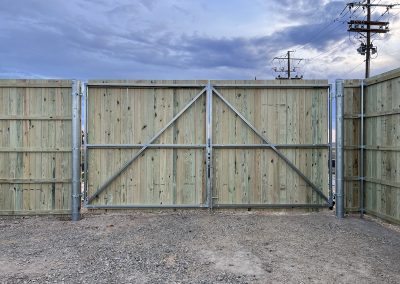
A pine double drive gate built on galvanized steel frames with diagonal steel braces, hung on round galvanized posts in a pine privacy fence, over a dirt and gravel pad, utility poles behind

Chain and Padlock or a Latch

How a gate locks depends on who opens it and how often. A business yard that closes at night often does fine with a heavy chain wrapped through both leaves and a padlock. It is simple, it is hard to pry, and anyone holding the key can get in. The tradeoff is that somebody has to climb out of the truck and handle a chain every single time.

A latch suits a gate that opens many times a day. It catches as the leaf swings closed, and most take a padlock through them for overnight. On any double gate, one leaf usually stays fixed with a drop rod pinned into the ground while the other swings. The pine pair in this photo hangs on round galvanized posts, each leaf on its own braced steel frame. We choose hardware rated for the weight of the leaf and mount it where the person opening the gate can reach it.

One Long Panel Across Gravel, or Two Leaves

A wide opening can take one long panel or a pair of leaves. A single panel means one hinge post, one latch and one big arc, and across a gravel yard that arc has to stay clear of parked equipment, stacked material and anything else that tends to land there. Two leaves each swing a shorter arc, put less weight on each post, and let you open just one side for someone on foot or a mower.

Gravel needs its own thought either way. We hang the bottom of the frame high enough to clear the gravel at the highest point of the swing, and we look at how water drains across the pad, since ruts form wherever it runs and a gate that drags on a rut twists itself out of square.

Most of the gates we hang go into a fence that is already standing. We tie the new posts into the existing perimeter so the line closes tight on both sides of the opening, whether that line is chain link, wood or steel, and we match the height so the gate never looks like an afterthought.

Hung, Braced and Locked Before We Leave

  • Opening measured against the widest vehicle and trailer that uses it
  • Each galvanized steel frame braced on the diagonal
  • Hinge and latch posts set in concrete and cured before hanging
  • Bottom clearance checked across the full swing over gravel
  • Lock or latch worked with you, and Kade Endl swings the gate himself before we pack up

Look through our project gallery for steel-framed gates we have hung. If you have an opening that needs a gate now, tell us how wide it is and what drives through it.

Gate Questions From Alexander Yards and Lots

How wide should a drive gate be for a trailer?

Wide enough for the biggest rig that uses it, plus room for the driver to turn in from the road. We measure the opening, watch the approach angle and allow extra width where a trailer cuts the corner. When in doubt we build wider, since a narrow gate gets hit.

Why do steel frame gates sag less than wood ones?

Galvanized steel keeps its shape under the weight of a long leaf, and a diagonal brace pushes that weight back toward the hinge post. Wood frames slowly give at the joints. Even with steel, the hinge post has to be set deep in concrete or the whole gate leans.

Can you put a wood face on a steel gate frame?

Yes. We hang pine boards on a braced galvanized frame so the gate matches a wood privacy fence while the steel carries the weight. The boards fasten with screws, and the frame keeps the gate square long after a wood-framed gate of the same size would start to drop.

Should I use a chain and padlock or a latch?

A chain and padlock suits a yard that closes at night and opens once in the morning. A latch suits a gate used all day, and most latches take a padlock too. We look at who opens the gate and how often, then fit hardware sized for the leaf.

Can you add a gate to my existing fence?

Usually. We set new hinge and latch posts in concrete, cut the existing line back to fit the opening and tie the new posts into it so no gap is left. Chain link, wood and steel perimeters can all take a new gate, matched to the height of the run.

Do you build gates for businesses as well as homes?

We do. Business yards, equipment lots and gated rural properties around Alexander all take the same steel-framed gates, sized and locked for how each one gets used. Delta Fence is a licensed, insured and bonded General Contractor, so a commercial owner gets the paperwork their records need.

Gated Drives Along Highway 5 South and Beyond

From yards off Highway 5 South to long country driveways along Collegeville Road and properties down toward the Saline River, we hang gates across Alexander. Fences to go with those gates are on the Alexander fence page. A gate usually joins a longer line, so look at chain link fencing for an equipment yard perimeter or a custom wood fence for the house side. If an older gate is dragging now, start with fence repair, and if the yard also holds a dog, see our dog kennel runs. Or ring the crew at (501) 626-7024 and describe the opening you have.

Fence Lines That Meet These Gates

Alexander Chain Link Fences

Long perimeter runs for acreage and equipment yards.

Chain link fences →

Alexander Custom Fences

Horizontal pine and cedar on steel, built to the house.

Custom fences →

Alexander Dog Kennel Fences

Runs along a tree line or off a shop wall.

Dog kennel fences →

Alexander Fence Repair

Rehung gates and reset posts on an existing line.

Fence repair →

Walk the Opening With Us

Send us the address, a photo of the opening and a word about what drives through it, from a pickup to a truck towing a trailer. We come out for a free on-site visit, measure the span, look at the ground where the posts will go and talk through the frame, the facing and the lock. Then we follow up with a written quote covering the posts, the gate and the hardware. Ask for our license and insurance papers with the quote if your lot needs them on file.

(501) 626-7024 kadeendl@gmail.com Book an on-site gate visit