Skip to content

Alexander Dog Kennel Fences

Out in Alexander a dog usually has more land than it knows what to do with, which is exactly why so many owners want a run: a fenced space where the dog can be outside without heading for the road or the woods. We build kennel runs in black vinyl-coated chain link, sized for the dog you actually have, with a walk gate that latches behind you and a bottom edge a digger cannot work its way under.

Shade

Black Chain Link Along the Tree Line

The run in this photo starts at the corner of a tan metal building, with wooden steps at the building, and follows a grassy backyard down along a wooded tree line. The fabric is black vinyl-coated chain link, and from the house it fades back into the trees. Plain galvanized wire would catch the light. Black reads as a shadow.

Setting a kennel along a tree line pays off in a couple of ways. The trees throw shade over part of the run for part of the day, which counts for a lot in an Arkansas summer when a dog needs somewhere cool to lie down. The woods also give the dog something to watch without letting it chase what it sees. We keep the fence a little off the trunks, so post holes do not chop through big roots and a growing tree does not end up leaning on the fabric.

The vinyl coating protects the wire underneath, and it is easier on a dog that likes to lean against the fence. Our dog kennel fences page covers the runs we build across Central Arkansas.
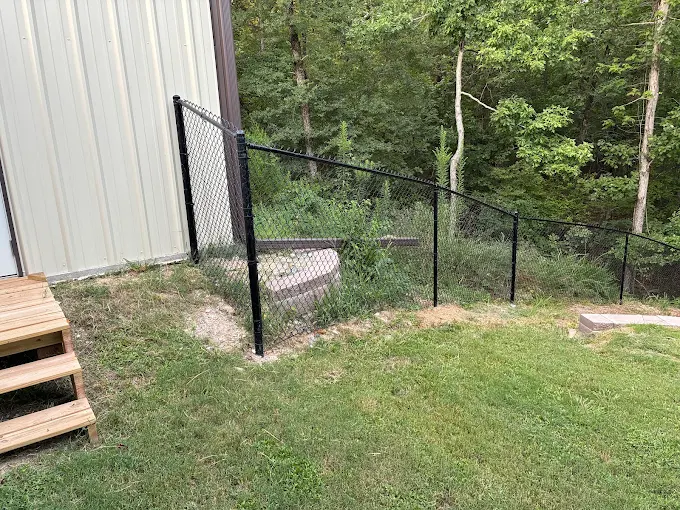
A black vinyl-coated chain link fence running from the corner of a tan metal building down a grassy backyard along a wooded tree line, wooden steps at the building

A Run Built Around the Dog You Have

There is no single right size. A dog that spends a couple of hours outside while you work in the shop needs less room than one that stays out most of the day. A big dog that paces wants length so it can really move. A small dog that slips through gaps needs the bottom edge kept closer to the ground than a large one ever would.

Height follows the dog as well. Some dogs never test a fence in their lives. Others jump or climb, and those get a taller run. If you have more than one dog, or expect to, size the run for the whole pack instead of the single pup sitting in the yard today. Adding a second run later is always more work than building the first one right.

On the visit we ask about breed, age and how the dog behaves at whatever holds it now, whether that is an old fence, a tie-out or nothing at all. We also ask where you want to stand when you call it in. That answer decides where the gate goes. A run should sit somewhere you can see from the house, so you know when the dog is ready to come back inside.

Stopping a Digger in Clay

Clay seems like it ought to stop a digger. It does for a while, until a week of rain softens the ground along the fence line and a determined dog finds it can scoop out a tunnel in an afternoon. Then the clay dries hard around the hole, and the escape route stays open for the next try.

We close the bottom two ways. A tension wire runs tight along the bottom of the chain link, so the fabric cannot be shoved up and out from under. For dogs that dig, we also bury an edge, carrying wire down into the ground along the run so a dog that starts a hole hits wire instead of open dirt. Where the run crosses a low spot, we keep the fabric close to grade so there is no gap to start from.

Posts go in concrete at proper depth, the same as every fence we build, so the corners do not loosen when a dog throws its weight at them. If your dog has already dug out of another fence, tell us where and how. It changes how we build the bottom.

A black vinyl-coated chain link walk gate between two black posts on a bare, sloped wooded lot

A Walk Gate That Latches Behind You

A run is only as good as its gate. The one in this photo is a black vinyl-coated walk gate hung between two black posts on a bare, sloping wooded lot, set where a person can step through with a water bowl in one hand.

The latch is the part that gets used most and thought about least. We fit one that catches when the gate swings shut, so if your hands are full or a kid lets the dog out, the gate does not sit open a crack. For a dog that has learned to nose a latch, we mount it higher or add a second catch. On sloped ground the gate gets hung to clear the uphill side of its swing without leaving a gap on the low side.

Which way it opens matters too. A gate that swings into the run lets you block an eager dog with your knee on the way in.

Using the Shop Wall as One Side

Plenty of Alexander properties have a shop or metal building out back, and that wall can save you a whole side of fence. A run built against it gets a solid side the dog cannot see through, some cover under the roof edge, and a short walk from the shop door when you want to check on it.

Bringing a fence up to a metal building takes care. Nothing gets fastened to the siding, and there cannot be a gap where the fence meets the wall, because a dog will find that crack fast. We set an end post in concrete tight to the building and stretch the fabric to that post so the corner closes. If the wall has a door, we plan the gate so the dog cannot slip out every time someone steps out of the shop.

Watch the runoff as well. Rain coming off a metal roof lands right along the wall, and in clay that strip turns to mud fast. We look at where the water falls and either keep the run’s corner out of it or plan a firmer surface there, so the dog is not standing in a puddle after every storm.

Checked With the Dog in Mind

  • Run sized for the dog’s build, habits and time spent outdoors
  • Bottom tension wire tight, with a buried edge where the dog digs
  • Walk gate latch catching every time it swings shut
  • No gap where the run meets a building, a tree line or a slope
  • Shade and drainage looked over, then a final walk with owner Kade Endl

Finished runs and fence lines are in our project gallery. If you can sketch where the dog spends its time now, send it through our contact page and we will come back with a layout to talk over.

Kennel Run Questions We Hear in Alexander

How big should a dog run be?

Big enough for your dog to move, turn and lie down in the shade, which depends on its size and how long it stays outside. A pacing dog wants length more than width. We ask about the breed, age and daily routine, then lay the run out with you before any posts go in.

Why black vinyl-coated chain link instead of plain galvanized?

Black coating blends into trees and grass, so from the house the run fades back into the yard. The coating also covers the wire, which protects it from the weather and is easier on a dog that leans against the fence. Plain galvanized works fine where looks matter less.

My dog digs. How do you keep it in?

We run a tension wire tight along the bottom of the fabric and, for diggers, bury an edge of wire into the ground along the run. Every post is set in concrete. If your dog has escaped a fence before, tell us how it got out, because that shapes how we build the bottom.

Can the run attach to my shop or barn?

Yes. We set an end post tight to the wall and close the corner so there is no gap a dog can squeeze through. Nothing gets fastened to the metal siding. We plan the gate around any door in that wall and look at where roof runoff will land inside the run.

Will the gate latch by itself?

We fit a latch that catches when the gate swings closed, so it does not sit open a crack when your hands are full. For dogs that learn to nose a latch open, we mount it higher or add a second catch. Gates on slopes are hung so they clear the ground.

Can you build a run on a wooded or sloped lot?

We can. We set posts around roots instead of through them, keep the fabric off the trunks and rack the fence to follow the slope so the bottom stays close to the ground. Shade from the tree line is a bonus for the dog on a hot Arkansas afternoon.

Country Lots From Collegeville Road to the River Bottoms

Dogs in Alexander live on all kinds of ground, from open acreage off Collegeville Road to wooded lots near the Saline River and newer yards off Highway 5 South, and we build each run for the ground it stands on. Our Alexander fence page covers the full list of what we build here. Owners often pair a run with a longer chain link boundary or a custom wood fence around the house. A braced drive gate keeps the dog off the road side, and fence repair can shore up an old line the dog has been testing. Call (501) 626-7024 with questions.

Other Work That Pairs With a Dog Run

Alexander Chain Link Fences

Boundary runs that keep a roaming dog on your land.

Chain link fences →

Alexander Fence Repair

Loose sections and leaning posts tightened back up.

Fence repair →

Alexander Secure Gating

Steel-framed drive gates that close the road side.

Secure gating →

Alexander Custom Fences

Wood privacy built to match the house and land.

Custom fences →

Tell Us What Kind of Dog It Is

Send the address, a photo of where you picture the run and a few words about the dog: its size, its age, and whether it digs, climbs or mostly likes to watch the woods. We come out for a free on-site visit, walk the spot, check the ground and the shade, and talk through the gate and the bottom edge. Then you get a written quote for the run as we would build it.

(501) 626-7024 kadeendl@gmail.com Plan the dog run with us